You cannot withdraw USDT to a card directly: a card takes hryvnias, so someone has to buy the USDT first. There are three ways: sell on an exchange's P2P platform, where the buyer transfers hryvnias to your card themselves; exchange it at an exchange service that pays out to a card; or sell it inside an exchange or wallet app, if the app can pay out to a card.
Choose not by the rate in a listing but by the amount that reaches the card after all deductions, and by who will be the sender of the transfer: the bank's questions depend on that. We are an exchange service and say so up front: with us, a payout to a Ukrainian bank card, for example Privat24 or monobank, is made by a manager by hand, who names the rate, the timing and the limits for the specific order.
Below: how the three ways differ, which network to choose, how to work out the final amount, what the bank sees, the step-by-step order, and what to do if what you hold is bitcoin.
Three ways to a card: how they differ
Either way, the money arrives on your card. The ways differ in who sends it, who sets the price and whose side the risk is on if something goes wrong.
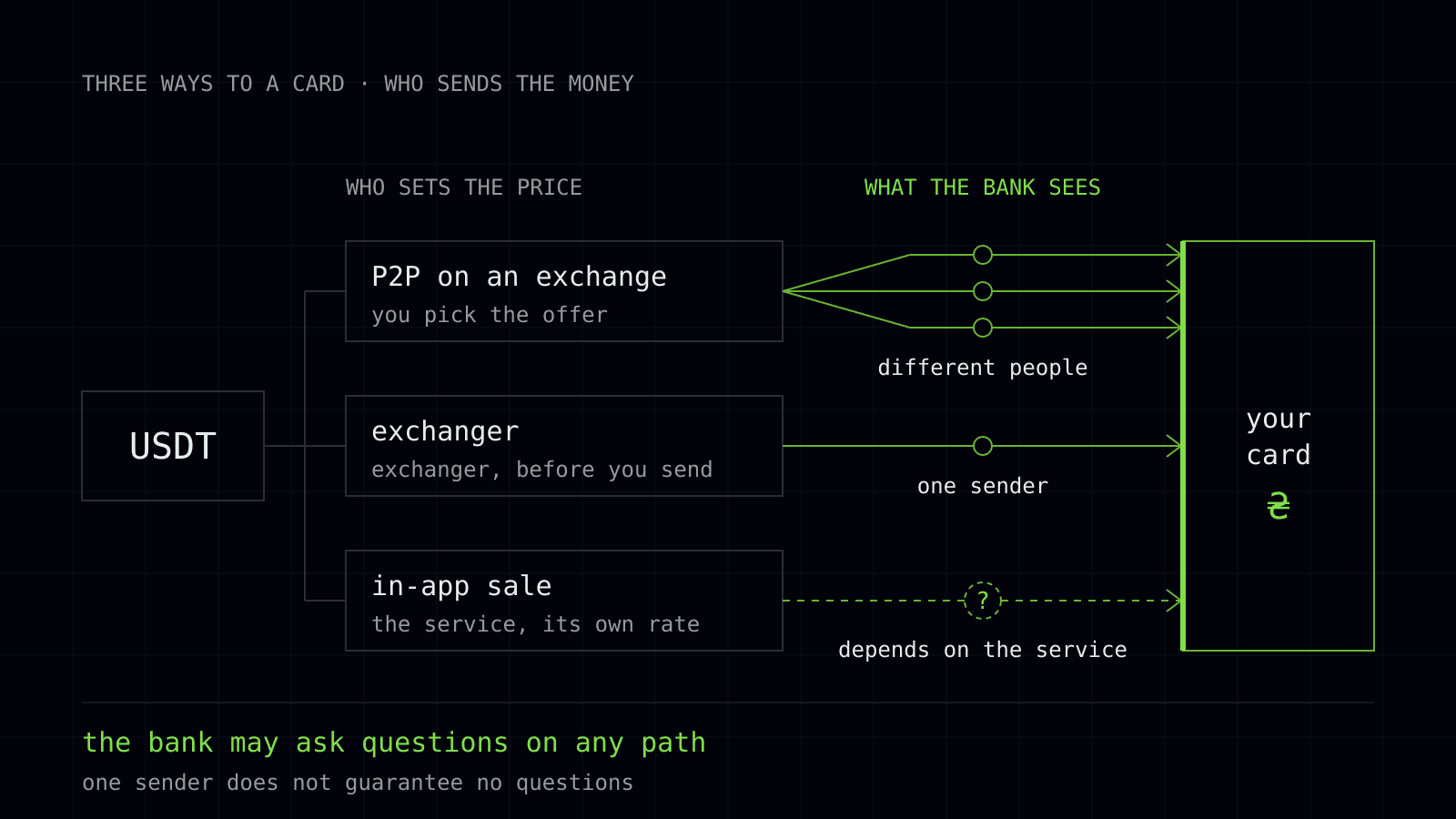
Criterion | P2P on an exchange | Exchange service | Sale in an app |
|---|---|---|---|
Who pays the hryvnias | The buyer, a private person | The exchange service | The service or a buyer it finds |
Who sets the price | You choose a listing | The exchange service, before the USDT is sent | The service, at its own rate |
What the bank sees | Incoming payments from different people | The sender the exchange service names | Depends on the service |
Main risk | Payment from a third party | A dishonest exchange service | The sender is not known in advance |
P2P on an exchange: you choose the price, the risk sits on your card
On a P2P platform you sell USDT to a specific person. The exchange holds your USDT for the duration of the deal, the buyer transfers hryvnias to your card, you confirm receipt, and only then does the USDT go to the buyer. That is how the P2P sections of the large exchanges, Binance among them, work.
The rate in a listing is not yet what will arrive. It is reduced by the network fee for sending the USDT to the exchange, by the listing's limits, which your amount may not fit into, and by the time during which the rate drifts. How to work out the final amount step by step is covered in the article on the final P2P rate on Binance.
The main risk of P2P is not the rate but who the money comes from. Two rules reduce it:
- Check the incoming payment in your banking app, not by the buyer's screenshot. Release the USDT only when the money is visible on the account.
- Do not accept payment from a third party. The sender's name must match the buyer's name on the platform. If an outside person is paying, you are looking at a “black triangle”: the money was sent by someone who was deceived, and the questions from the bank and the police come to the USDT seller.
An exchange service: a manager makes the card payout
At an exchange service you have a single counterparty, and it names the price before you send the USDT. We are an exchange service, so we describe our own setup: hryvnia payouts to a card go not through an automatic form but through a manager. There is no live “to card” rate on the site; the manager names it for each order.
Along with the rate, the manager names what depends on the day and the amount: how many hryvnias will arrive, within what time, what restrictions apply and which banks we currently work with. These figures are deliberately left out here: in an article they would go out of date before you finished reading it.
Two banks have separate pages: exchanging USDT to Privat24 and exchanging USDT to monobank. If your bank is a different one, write to the manager from the page for selling USDT for hryvnias. Before sending USDT, ask:
- how many hryvnias will arrive on the card — as a final amount, not as a rate;
- how long the quoted rate holds;
- in which network, to which address and at what moment to send the USDT;
- who the transfer will come from and with what payment reference — so that if the bank asks, you can explain what the money is.
An exchange service may check the origin of the incoming coins: this is an AML check of the USDT's history, not of you as a person. For large amounts, the law allows the service to ask for an identity document. And one sender instead of a dozen does not guarantee that the bank will have no questions — more on that below.
From a wallet to a card: Trust Wallet and the like
An ordinary wallet such as Trust Wallet does not pay out to a card by itself: all it can do is send USDT to an address. So withdrawing from a wallet means sending USDT to where it will be exchanged for hryvnias: to an exchange for P2P, to an exchange service, or to a service with a sell function. How to send USDT from Trust Wallet without losing money on the fee is covered in a separate guide.
Some exchanges and wallets offer to sell USDT for hryvnias inside the app and withdraw to a card with one button. Their terms are their own and they change, so look at two things: the amount to be credited after all deductions, and who the transfer will come from. If what sits behind the button is a buyer who is a private person, for your bank it is the same P2P deal.
Which network to choose: TRC20 or ERC20
The network is set by two sides: which network your USDT sits in and which network the recipient accepts it in. The two must match. A transfer in a network that the recipient's address does not support can end in the loss of the funds; what to do if that has already happened is in the article on sending to the wrong network.
The network fee does not depend on the amount, so on a small withdrawal it is noticeable. Its size depends on the network and how busy it is, and the wallet or exchange shows it before sending. As a reference point, a measurement on 19.09.2026: a USDT transfer in TRC20 from an ordinary wallet cost about $2.17, or $4.41 to an address that had not yet held USDT, while in ERC20 it was about $0.28 and only cents in a quiet hour.
That is one day's state, not a rule: the price in both networks changes with the coin's rate and the load, so compare by the figure in the wallet, not from memory.
To send in TRON, the wallet needs TRX for the fee; in Ethereum, ETH: without it the USDT will not go. In the same measurement, one transfer in TRON burned about 6.4 TRX, so keep a reserve of 15–20 TRX.
A transfer in TRON shows up in the explorer almost at once, while final confirmation in the same day's measurement took 57 seconds — how to check it in Tronscan. What the fee is made up of is covered in detail in the article on network fees.
How much reaches the card: working out the final amount
The final amount is made up of four parts: the rate at which your USDT is bought, the network fee, the service's fee if there is one, and the bank's charge for crediting, if your bank takes one under its own tariff. The advertised rate reflects only the first part.
A hypothetical example; the figures are an illustration, not a rate. You withdraw 300 USDT and the transfer costs about two dollars — in the network's coin from the wallet or as a deduction on the exchange. That is two dollars out of 300 that will not reach the card. On 3,000 USDT the same two dollars are barely noticeable. That is why a small amount is better sent in one transfer rather than several.
The ways can only be compared fairly by one figure: how many hryvnias end up on the card. On P2P you work it out yourself; an exchange service and an app name it before you send the USDT. If you are only given a rate, ask for the final amount and how long it holds: while you wait, the USDT to hryvnia rate can shift.
The benchmark for comparison is the market rate. It is shown on the USDT rate page next to our cash rates and the NBU's official dollar rate.
What the bank will see and when it asks questions
We have not found a specific rule that would prohibit receiving hryvnias on your own card for cryptocurrency you sold. But the absence of a ban does not mean there will be no questions. Under Law № 361-IX the bank is obliged to monitor its clients' transactions, and it looks not only at the amount but also at whether the incoming payment resembles your usual profile.
The UAH 400,000 threshold applies only to mandatory monitoring and is triggered only if one of the indicators in Article 20 is present, for example a cash transaction or a transfer abroad. A suspicious transaction has no threshold: under Article 21 a question can come even about a small amount. Why this is so is covered in the article on financial monitoring.
For P2P, the pattern of incoming payments matters. Among the suspicion indicators in Annex 20 to the Regulation on financial monitoring in banks (NBU Resolution № 65) are many payments of small amounts that then move on as a single sum, and transactions that do not match the client's income and occupation. Frequent transfers from different strangers are the first half of that picture; if the whole amount then leaves in a single payment, the second half matches too.
Card-to-card transfers between individuals are also limited by the banks that joined the memorandum: according to media reports, UAH 100,000 a month for clients with low and medium risk. This is an agreement among banks, not an NBU rule, and the text of the memorandum has not been published; details are in the article on the 100 thousand limit.
If the bank has questions, it can suspend the transaction for 2 business days; the State Financial Monitoring Service has the right to extend that to 7, and in the extreme case it reaches 30 business days (Article 23). Another option is restricting debit transactions until documents are received. What to do in that case is in the article “Card blocked after P2P”.
No service can promise that the bank will not ask questions, and neither can we: the decision is the bank's. A payout from a single sender does not change that: the bank has its own assessment of the client's risk, and activity involving virtual assets is a separate factor in it.
How to prepare for the bank's question
Receive money only on your own card. A relative's or acquaintance's card does not solve the problem but creates a new one, this time for them, and these are exactly the schemes banks look for. The payment reference must state what actually happened.
Keep the chain from the very start: where the money you bought the USDT with came from; the transaction history on the exchange or at the exchange service and the transfer hash; the hryvnias arriving on the card. A single statement from an exchange covers only the middle of that chain. Which documents confirm it is covered in the article on the source of funds.
Do not split the amount to stay out of the bank's sight: many small incoming payments that then leave as a single sum are precisely an indicator from the NBU's list. We do not recommend such tricks: they do not remove questions, they add them.
Do you have to pay tax on a withdrawal
Yes. As of August 2026, income from selling cryptocurrency is taxed: 18% personal income tax and 5% military levy — on this the tax authority and lawyers agree. The dispute is about the base: according to the tax authority's clarifications, the whole amount received is taxed, lawyers insist on the profit, and there is no direct rule in the Tax Code. The dispute is examined in the article “The whole amount or the profit”.
For the conversation with the bank this matters doubly: the strongest document on the source of funds is considered to be a filed tax return showing the income from cryptocurrency. The rates and the tax authority's position change, so check against the version in force on the filing date.
Step by step: withdrawing USDT to a card through an exchange service
- Write to the manager. Give the amount in USDT, the network it sits in, and the bank whose card the payout should go to.
- Get the terms. The manager will name the rate, the amount to be credited, the timing and the restrictions. Ask the questions from the list above.
- Check the network and the address. The network in your wallet must match the one you were given. Paste the address by copying it and check the first and last characters.
- Check you have the coin for the fee. For TRC20 you need TRX with a reserve, around 15–20 TRX; for ERC20, ETH.
- Send the USDT at the agreed moment and keep the transfer hash. It shows that the transfer went out and when.
- Wait for the payout and check it in your banking app. Keep the correspondence with the manager and the hash: they are part of the document chain if the bank asks.
When cash is more convenient
If you need hryvnias or dollars in cash, the card is unnecessary. This is our main format: USDT is exchanged for cash in six cities — Kyiv, Kharkiv, Dnipro, Odesa, Lviv and Chernivtsi. Which directions are open in a city right now is shown by the table on the rate page; it updates roughly every minute.
The order is created on the site, the rate in it is locked for five minutes, and a manager agrees the time of the visit to the cash desk. How the meeting goes and what to bring is described in the article on cash exchange.
Cash cancels neither the tax nor the questions about the source of funds. If you later deposit it to an account, a cash transaction is one of the indicators in Article 20, and from the threshold amount it falls under mandatory monitoring.
If you hold bitcoin, not USDT
Bitcoin and other cryptocurrencies are withdrawn to a card the same ways: they are sold on P2P for hryvnias, or first exchanged for USDT on an exchange, and then you proceed as described above. Bitcoin has its own network and its own fee, and confirmations in it take longer than in TRON.
We currently accept USDT and USDC; bitcoin is not among our directions. So for bitcoin, the route to our card payout or to cash goes through an exchange into USDT. Whether USDC is accepted for a card payout, the manager will tell you.