
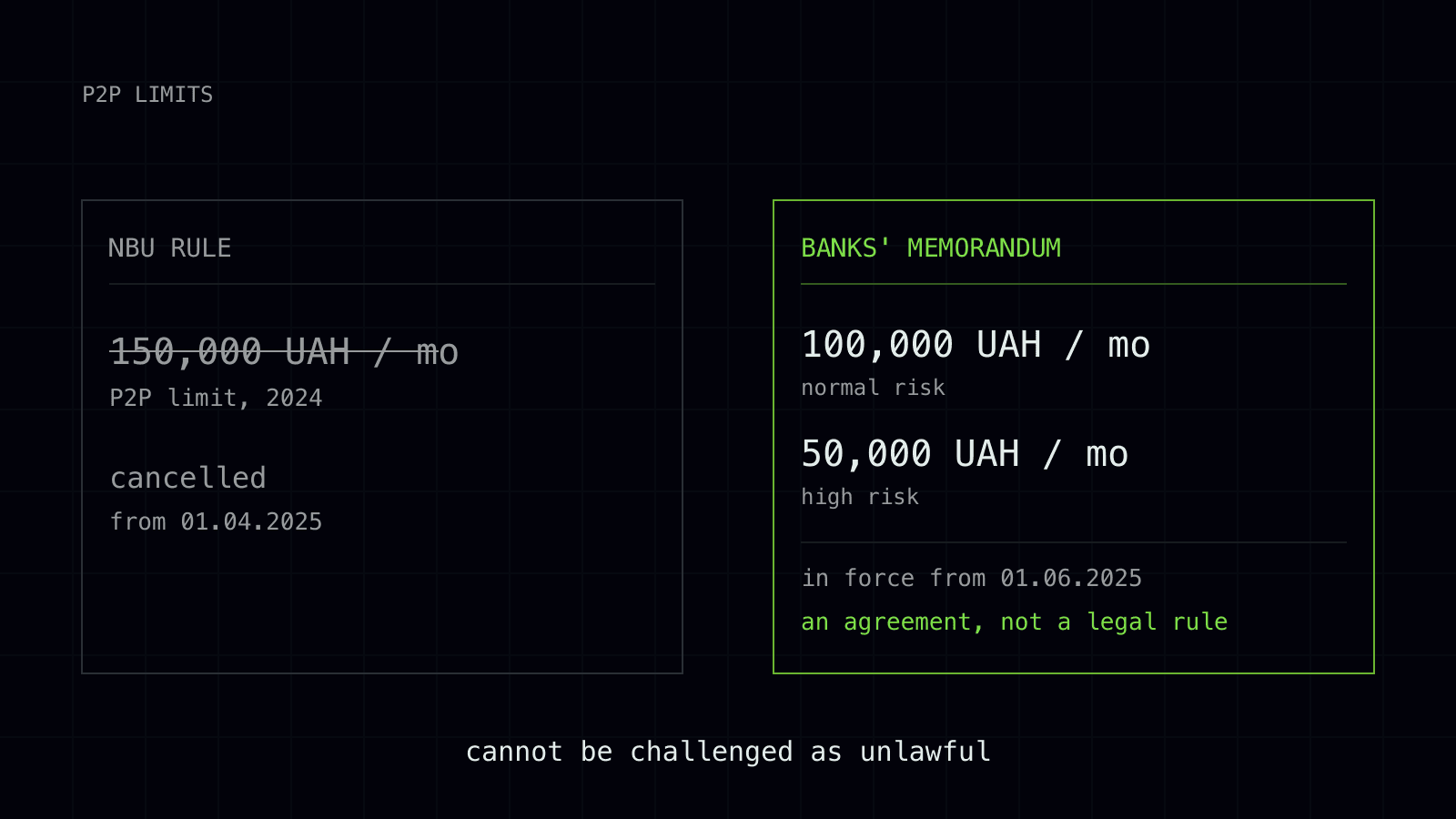
The UAH 100,000 monthly cap is not a National Bank resolution and not a clause of any law. A state limit did exist: the regulator introduced a temporary ceiling of UAH 150,000 per month for P2P transfers between individuals in October 2024 and did not extend it.
Since 1 April 2025 there has been no state cap. The current hundred thousand is a memorandum banks signed among themselves. That is why you cannot challenge it as unlawful: the bank breaks nothing, it follows an agreement it made itself.
The difference is not theoretical. A rule of law is the same for everyone and can be challenged in court. An agreement between market participants holds exactly as far as a particular bank chooses to honour it.
Hence the main practical nuisance: with the same passport and the same turnover, two banks will treat you differently.
One caveat up front, and it applies to everything below. The text of the memorandum has not been made public. Every limit figure is known only from press accounts, and that is a single point of failure for this whole section: if the reporting is inaccurate, so are the numbers in this article.
What exactly the National Bank cancelled, and when
The UAH 150,000 monthly limit was a temporary instrument. It was introduced in the autumn of 2024 in response to card-to-card transfer schemes, and it came with an expiry date.
The regulator did not extend that date. So since 1 April 2025 Ukrainian law contains no rule setting a monthly transfer ceiling for an individual.
That does not mean a transfer of any size will pass unnoticed. Removing the limit removed a number, but it removed neither mandatory financial monitoring nor the bank's right to halt an operation that does not match the client's profile.
A limit and monitoring are different mechanisms, and one does not substitute for the other. The threshold for mandatory financial monitoring is UAH 400,000, Article 20 of Law No. 361-IX, and it is about something else entirely: not monthly turnover, but a single operation carrying a particular feature.
And the amount alone under Article 20 decides nothing: an operation becomes a threshold operation only when one of the listed features is added to the amount, a link to a state that fails to follow FATF recommendations, a politically exposed person, a cross-border transfer or cash. A suspicious operation under Article 21 has no threshold at all.
Rule of law versus agreement: where the real difference lies
This is not a legal nicety for collectors. It is the difference between where you take your complaint and whether that complaint stands a chance.
A rule of law is created by the state, applies equally to every bank and has an addressee for appeals. If a bank breaches a National Bank resolution, a complaint to the National Bank works, because the regulator supervises compliance with its own acts. The last resort is court, and the subject of the claim is precisely the breach.
An agreement is a deal between private parties. The state did not adopt it, does not supervise it and cannot cancel it by a single decision.
A bank that applies a memorandum limit has breached nothing: it did what it signed up to, within the service contract you signed.
The practical conclusion is simple. A complaint to the National Bank arguing that no such limit exists in law has no subject matter. There is one meaningful route, a conversation with the bank itself: explain the turnover, show documents, change the product or tariff if needed.
What the banks' memorandum is and who signed it
A memorandum is a voluntary agreement among market participants to apply the same rules. The current version was signed by the Association of Ukrainian Banks and the Independent Association of Banks of Ukraine, 31 banks joined, and there are more than 50 participants in total.
The restrictions have applied since 1 June 2025 and were retained in the version dated 14 May 2026.
Let us repeat the caveat, because it matters most here. All these figures, the dates and the number of signatories alike, come from the media. A reader cannot check the wording against the primary source, and neither could we. Treat the numbers as a rough guide, not as the text of a rule.
A separate word on the nature of such an agreement. A memorandum carries no sanction for non-compliance of the kind a law carries. A bank that decides to depart from it risks its standing in the association, not a fine. That is why banks do not behave identically down to the last hryvnia.
The actual figures: 100 thousand and 50 thousand
According to the same press reporting, two ceilings apply to individuals: UAH 100,000 per month for low and medium risk clients, and UAH 50,000 per month for high risk clients.
The risk level is set by the bank itself under its own AML procedures. It is not a public rating, not a regulator's decision and not a number anyone is obliged to tell you.
Clients usually learn their level indirectly, from the amount at which a transfer stopped. Banks do not answer the question of what your risk level is, and there are no grounds to demand it.
Hence the answer to the most common question: why a transfer goes through at one bank and not at another. Because these are different internal risk assessments made within one voluntary agreement.
Why the cap works differently at different banks
A bank applies the cap not to an abstract client but to the profile it has built of you. The divergence starts right there: at different banks you have a different history, a different salary flow and a different set of income sources known to the bank.
Then the counting method differs. One bank counts outgoing card transfers, another counts all incoming payments from individuals, a third counts both.
The period differs too. One bank counts a calendar month, another a rolling thirty days. Banks do not disclose these details publicly, so what we describe here is a picture assembled from bank notices and customer complaints, not a regulatory procedure.
Behaviour at the threshold differs as well. In some cases the operation simply fails with a generic error message, in others a document request arrives, and in others the cap is applied more softly once the client has explained the turnover in advance.
The practical conclusion: ask your own bank what your limit is, and ask in writing, through a request in the app. One bank's answer does not carry over to another, and somebody else's forum experience is no help here.
What the cap does not cover
First things first: there is no official list of exceptions. What follows is known from banks' own notices and media coverage; we have not seen the primary source. This is not a rule and not a guarantee, it is a rough guide.
According to those notices, the monthly ceiling usually does not catch transfers between one person's own accounts and cards, both inside a bank and between banks.
The logic is clear: sender and recipient are the same person, so the many-to-one pattern never appears.
Sole trader accounts are named on the same basis. Business activity has its own regime, its own reporting and its own way of explaining turnover, and measuring it against a private card ceiling makes no sense.
And separately, utility payments, taxes and other settlements with institutions. That is, payments where the recipient is obvious and is not an individual.
Check this list with your own bank rather than in an article. The bank applies its own version of the rules, and that version decides what happens to your particular operation.
What to do if your turnover is legitimately larger
First, what not to do. Splitting an amount into smaller transfers is not a way out but a risk criterion in its own right; more on that below.
There are several workable routes, and all of them go through the bank rather than around it.
The first is to bring your legal form in line with your turnover. If money arrives regularly and in payment for services, that is entrepreneurial activity, and a sole trader account with the right activity code explains the turnover by itself. This is a tax decision, and it is worth discussing with an accountant.
The second is to tell the bank about your expected turnover in advance. Banks update the client questionnaire both on their own initiative and on yours.
A submitted package of source of funds documents changes the risk assessment before an operation stops, not after. That is the cheapest moment for the conversation, because the money is not yet frozen.
The third is declaring your income. A filed return with declared crypto income is the strongest document in a conversation with a bank, because it carries the weight of the State Tax Service rather than an export from your exchange account. We covered this separately in our piece on source of funds.
The fourth is choosing a way to sell in which the hryvnia arrives from a single legal entity under a single contract, rather than from a dozen strangers.
We are an exchange service, and this is directly to our benefit: with us there is one payment and one sender. Even so the bank asks questions, and documents are still needed: the sale method changes the picture on the account, it does not exempt you from checks.
What to do if a transfer has already been stopped
First, establish what actually happened. A cap triggering, a document request and an operation suspended under Article 23 are three different situations with different deadlines, and confusing them is expensive.
Second, find the date in the bank's letter. The law sets no statutory deadline for a client's reply; the bank sets it through its own internal procedure. So the date in the request is the only real deadline you have.
Third, write, and write through an official channel: a request in the app or the email address given in the letter. A hotline call leaves no trace, and the financial monitoring unit reads the correspondence.
Fourth, answer the substance of the question rather than the substance of your grievance. The argument that no such limit exists in law does not work here, for the reasons set out above, and it only takes up space in the letter.
Does the cap apply to sole traders and companies
According to press reporting, the memorandum sets ceilings for individuals specifically. Settlements by sole traders and legal entities live under different rules: there are contracts, source documents and reporting, and the bank assesses the operation against them.
That does not make a business account a check-free zone. Mandatory financial monitoring under Article 20 and suspicious operations under Article 21 apply equally to everyone, and the risk criteria in Ministry of Finance Order No. 465 draw no distinction based on the account holder's status.
The difference lies elsewhere: a sole trader has a way of explaining turnover that banks are used to. An individual with active P2P has no such way, and that is exactly why the same amount reads differently.
Why this cannot be challenged as unlawful
You challenge a breach of a rule. If there is no rule, there is no breach. A bank applying a ceiling from its own memorandum acts within the service contract and its own rules, not against the law.
A complaint to the National Bank arguing that no such limit exists in legislation does not change that logic: the absence of a state cap creates no obligation for a bank to process any given transfer. The regulator supervises compliance with its own acts, not with other parties' agreements.
So the realistic route is not a dispute about legality but work on your risk level: clear payment descriptions, source of funds documents ready to hand, and no pattern that a bank reads as pass-through activity.
We are an exchange service, not lawyers, and in every specific case the decision rests with the bank.
Why working around the cap makes things worse
Splitting transfers is not a neutral tactic but a risk criterion in its own right. Ministry of Finance Order No. 465 of 28 December 2022, in force since 24 February 2023, expressly lists the splitting of operations to circumvent thresholds among its criteria.
The same list names repeated operations whose character gives grounds to believe their purpose is to evade mandatory financial monitoring procedures.
So by breaking up the amount a person does not escape attention, they create a new reason for it. And a reason named in an official document, not in one bank's internal manual.
The same list also covers payments from unrelated third parties and the use of an account as a pass-through, the classic picture of active P2P.
There is no separate official ban on P2P, and that is exactly why the wording has to be careful: the absence of a ban is not a permission. Banks' objections rest not on a rule saying P2P is prohibited, but on the general risk-based approach.
Why banks tightened up right now
The context is the growth in so-called drops, front men holding cards. According to figures cited in industry reviews with reference to the National Police, the number of drops identified rose from roughly 2,194 in 2020 to 26,700 over nine months of 2025.
We have not verified these figures against the primary source, so we cite them as an order of magnitude rather than exact statistics.
Even with that caveat the direction is clear. The memorandum's caps are the market's response to mass schemes, not to any individual client. A bank counting your monthly turnover is solving its problem, not yours.
Someone who sells cryptocurrency a few times a month falls into the same statistical picture as a drop: many incoming payments from different senders, a short time on the account, fast onward withdrawal.
Automated systems see the shape of an operation, not the intent. The only thing that tells them apart is what a drop cannot supply: a clear source of funds, documents along the chain and a willingness to answer a request on time.
What may change next
On 21 July 2026 the National Bank published a draft resolution on indicators of suspicious payments. It sets out 16 indicators and three risk levels: low passes automatically, medium requires confirmation, high stops the operation.
The indicators named include more than 10 top-ups within 60 minutes, minimal balances alongside large turnover, fast onward movement of funds, and one-to-many and many-to-one transfers.
This is a draft, nothing more. Public consultation ran until 31 July 2026, and we have not verified whether the document had been adopted as of the date of this article: the regulator's pages are closed to automated requests. Calling these indicators a rule in force would be a mistake.
It is worth saying separately what the draft does not contain. Neither P2P nor cryptocurrency is mentioned in it. The indicators are described through the shape of payments, not through the asset behind them, and attributing statements about crypto to the draft is not on.
In practical terms this means one thing for readers: if the document is adopted, 90 days are allowed for adaptation afterwards. So any changes, if they come, will not come suddenly.