

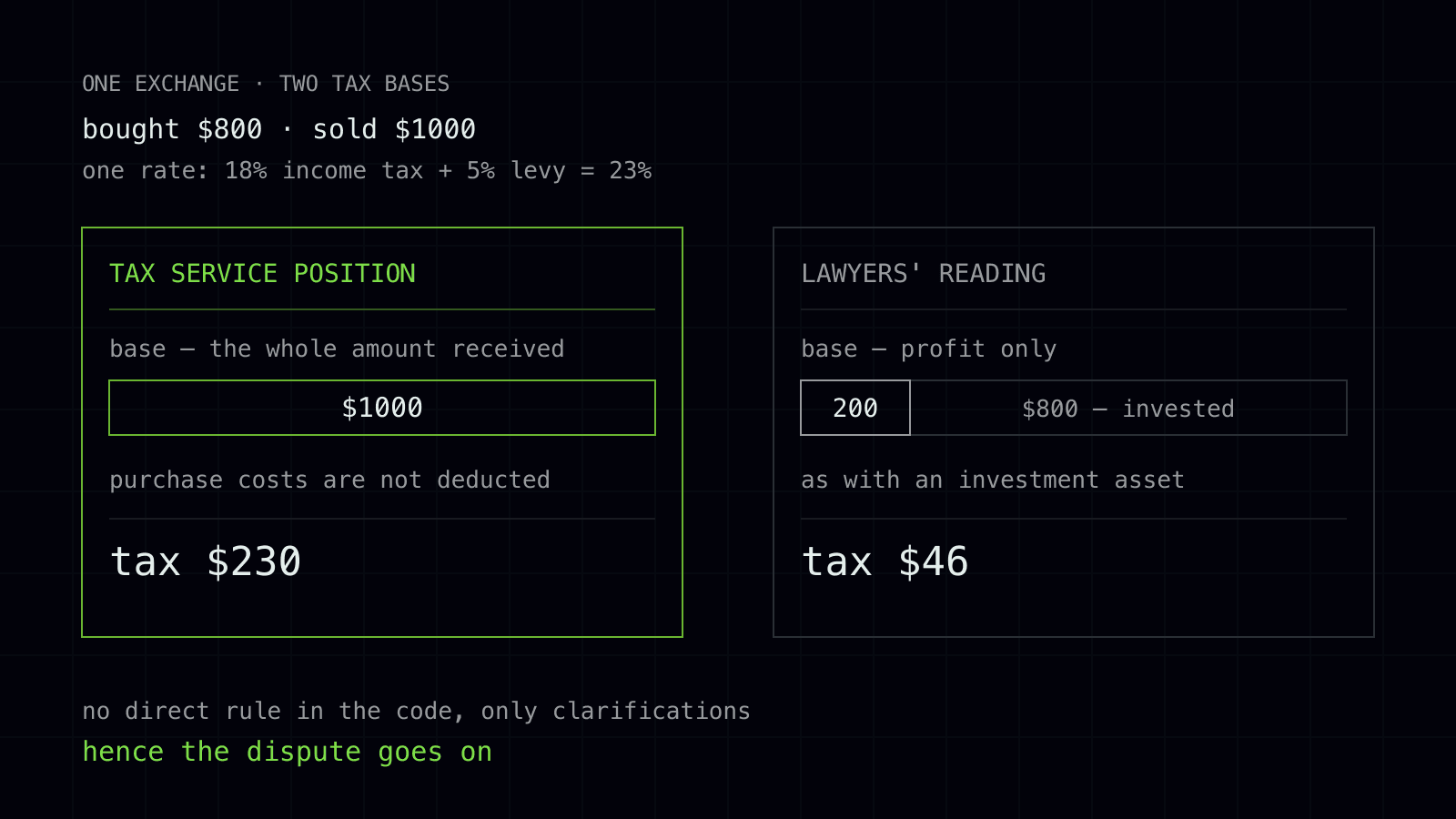
The rate raises no doubts: 18% personal income tax plus 5% military levy, 23% in total. The argument is about something else, namely what that rate applies to. Under State Tax Service clarifications, what is taxed is the entire amount of funds received from crypto transactions. Under the reading of law firms and most articles in search results, it is the profit only, the difference between the sale price and the purchase price.
There is no provision in the Tax Code that would settle this question. Neither the tax authority's position nor the lawyers' reading rests on a direct rule: both sides build it out themselves.
Both answers sound equally confident, which is exactly why they are easy to mix up. On a thousand-dollar exchange it is the difference between tax on a thousand and tax on two hundred.
About us up front: we are an exchange service, not a tax adviser. Below is what is known and where it comes from, without the advice only an accountant who knows your situation can give.
Is crypto income taxed at all
Yes. The State Tax Service position is unambiguous: income from crypto transactions is included in an individual's total annual taxable income and is declared by the person.
The fact that cryptocurrency has no separate status in legislation grants no exemption. The code taxes income, not a list of permitted sources.
The confusion comes from the framework law «On Virtual Assets» No. 2074-IX. It was passed back in February 2022 but never entered into force: the Verkhovna Rada page still carries the note «has not entered into force».
Hence the common conclusion that «crypto is unregulated, so there is no tax». It is wrong. What is unregulated is the status of the asset, not the duty to declare funds received.
How cryptocurrency is taxed in Ukraine in 2026
Two rates that add up: 18% personal income tax and 5% military levy. That is 23% of the base. Ukraine has no separate «crypto tax»: the general rates for individual income apply.
The 5% military levy rate has applied since 1 December 2024 (Law No. 4015-IX). Before that date it was 1.5%.
A detail inside the rule matters: the rate is set by the date the income was accrued, not the date of payment. One and a half percent applies only to income accrued before 1 December 2024.
The practical consequence is this. A large share of crypto material in search still counts the levy at 1.5%, and that is not «a different case», it is an outdated figure. State Tax Service clarifications written before December 2024 are outdated the same way, but only on the rate; on how income is classified they can still be relied on.
A caveat: we did not check the code provision itself (clause 16-1 of subsection 10, section XX) against the primary text, the page returned only metadata. The rate is confirmed by a State Tax Service page and secondary sources.
Two answers to one question
A reader who has sold cryptocurrency and sat down with the return finds two versions in search. One comes from the sites of regional tax offices. The other comes from law firm blogs and business media coverage.
Neither side argues with the other openly: each simply presents its answer as the only one. Spotting the discrepancy is left to you.
The difference here is not stylistic. It is in the tax base, the figure that 23% is multiplied by. The base decides how much money goes to the budget, and it is measured in multiples, not percentage points.
What the tax authority literally says
The State Tax Service position in its clarifications is this: total annual taxable income includes the amount of funds received from crypto transactions. Not the difference, not the result, but the amount received. Purchase costs do not reduce the base.
There is logic behind this, and it is formal. The rules on taxing investment income, which expressly allow the cost of acquiring an asset to be deducted, apply to investment assets: securities, corporate rights, derivatives.
Cryptocurrency does not belong to that list; Ukrainian law does not recognise it as an investment asset. No asset, no rule about costs.
The income is then classified either as foreign, if the paying source is abroad, or as other income, if a resident pays.
A caveat this section would be incomplete without: we could not verify the dates of these clarifications. The tax authority site returns an access error on a direct request, so we rely on page copies and secondary sources.
Why cryptocurrency is not an investment asset
Because the list of investment assets in the code is closed. It is not a set of examples you can extend by analogy but an exhaustive list: whatever is not named in it does not belong to it.
Cryptocurrency is not named in that list. Not because of a ban and not by oversight: when the provision was written, no such asset existed in the legal landscape.
This is where the entire position of the tax authority grows from, and this is its formal strength. The rule on deducting acquisition costs is tied not to the everyday sense of the word «investment» but to the status of the asset.
Three consequences follow, and they come as a package. Deducting purchase costs does not work. Netting profitable transactions against loss-making ones does not work. Carrying losses forward to later periods does not work.
Each of those rules lives in the investment income regime, not in the general provision on income. Losing the asset status, you lose not one relief but the whole calculation mechanism.
And this shows straight away why a clarification cannot settle the argument. Only a law can add cryptocurrency to the list: no interpretation gives an asset a status the text does not contain.
Foreign income or other income: what it affects
Crypto income is classified along one of two routes. If the paying source is foreign, it is foreign income. If a Ukrainian resident paid the funds, it is other income.
The choice does not affect the rate at all. In both cases the same 18% plus 5% applies: the general provision sets no different rates for these categories.
It affects the line of the return. Foreign income and other income are reported in different places on the form, and putting the amount in the wrong one means filing an incorrect return with a correctly calculated tax.
In practice the question comes down to one thing: who sent you the money. A payout from a foreign exchange and a payout from a Ukrainian counterparty send the very same sale to different lines.
Foreign income adds another dimension: tax paid abroad and the rules for crediting it. We did not check that part and do not describe it, as it depends on the specific jurisdiction.
How a clarification differs from a legal provision in force
The difference is not in persuasiveness but in binding force. A provision of the code binds everyone: the taxpayer, the tax authority and the court. A clarification expresses the position of the body that wrote it.
Hence the practical consequence. A position set out in a clarification can be challenged: it is not the final reading of the law. A provision cannot be challenged; it can only be complied with or broken.
This works both ways, and the second way is worth saying out loud. The absence of a provision does not make a clarification optional in practice: it is exactly what the tax authority will act on when it looks at your return.
So a person ends up between a position that is not law and an interpretation that is not law either. The choice is not between right and wrong but between two unsettled options.
The price of that choice is measured not only in tax but in whether you are ready to take on a dispute. This is not legal advice but a description of the layout: the decision here belongs to the taxpayer together with the specialist who answers for it.
Why lawyers count differently
The opposing argument does not cite a special provision, because there is none. It rests on the general logic of income tax: what is taxed is the gain, the economic benefit, not the turnover.
If you bought at 800 and sold at 800, no income arose at all and there is nothing to tax. Selling your own property at the same price does not make you richer.
The argument looks reasonable, which is exactly why it spreads. But it is an interpretation, not the text of the law. The tax authority's position is not fixed in a provision of the code either. Both sides build out a rule where the legislator never wrote one.
What is at stake, with an example
Let us count on illustrative numbers. Say you once bought 1,000 USDT stablecoins and spent a notional 800 units on them, then swapped them into fiat and received a notional 1,000. The profit is 200.
Under the tax authority's version the base is the whole 1,000 received. Tax: 1,000 × 23% = 230. That is more than everything you earned on the transaction.
Under the lawyers' version the base is the 200 of profit. Tax: 200 × 23% = 46.
The gap is 184 units on a single transaction, a factor of five. The numbers here are illustrative and chosen for clarity: real ones depend on the rate, the amount and the number of transactions.
But the proportion always holds, and the closer the sale price is to the purchase price, the more painful the gap. On a sale at a loss the first version still produces tax.
How trading is taxed
The same way as a one-off sale. The law provides no separate regime for active trading by an individual: no reduced rates for turnover and no right to net profitable trades against losing ones.
This is where the disagreement over the base costs the most. A trader makes hundreds of transactions, and if every amount received counts as the base, the taxable «income» for the year will easily exceed the real money in hand.
The rule on carrying losses forward, which works for investment income from securities, does not apply to cryptocurrency, for the same reason as the rule on costs.
What to do about it in practice: export your full trade history regularly, not in April. Exchanges limit how far back exports go, and reconstructing a year of trading after the fact does not always work.
Does tax arise on a crypto-to-crypto swap
There is no official answer. We found no direct clarification on whether taxable income arises when one cryptocurrency is exchanged for another without cashing out into hryvnia.
The logic of the existing clarifications points indirectly to the moment funds are received. But that is our reading of someone else's text, not the tax authority's position, and we will not present it as an answer.
Draft law No. 10225-d, which has not been passed, proposes taxing only conversion into fiat. That is a pointer to the future, not a rule in force.
The honest answer here is «unknown». If you have a lot of internal conversions, this is exactly the case you take to an accountant rather than to an article.
Is it legal to receive a salary in cryptocurrency
Here we step past the ground we verified, and we say so plainly. We found no State Tax Service clarification specifically on paying wages in cryptocurrency, so a confident answer would be invention.
What is known for certain: the framework law on virtual assets never entered into force. So the status of cryptocurrency as a means of payment in Ukraine is unregulated.
What follows for tax: the payment received remains income and does not stop being income depending on what it was paid in. The question is not whether there is tax.
The question is how such a payment is documented in employment relations and under currency regulation. That is no longer the tax dimension, and we will not take it on in an article about the tax base. You need a lawyer.
What the law that has not been passed would change
Draft law No. 10225-d has not been passed. We checked this directly on its card on the Verkhovna Rada site on 21 August 2026.
The timeline is short. Registered on 24 April 2025, committee opinion the next day, adopted in the first reading as a basis on 3 September 2025. After September 2025 the card shows no events at all.
Adoption has been pushed back at least to the autumn. The reason given is that the National Bank of Ukraine and the securities commission failed to agree on the regulator's powers. That is a member of parliament's position as relayed in the press, not an established fact.
The first-reading text contains a preferential rate of 5%: on profit from conversion into fiat during the first year after the law enters into force. Plus a one-off transitional declaration of previously purchased cryptocurrency at 5% personal income tax and 5% military levy.
That figure has to be read with two corrections. First: this is the first-reading text and it may change before the second. Second: the text prepared for the second reading is not publicly available.
And the main point: this rate is not a rule in force. Planning a sale around 5% today means planning around a provision that does not exist.
What nobody has
There is no direct provision in the Tax Code describing the taxation of income from crypto transactions. There are tax authority clarifications, which are not provisions, and lawyers' interpretations, which are not provisions either.
That means the question is open not because we failed to work it out but because it is objectively unsettled. Any text that gives one confident figure here is leaving out half the picture.
What this means in practice
Keep proof of the purchase price. This is the one piece of advice we are willing to give, and it works whichever way the dispute goes.
If the profit reading wins, a cost document is what you calculate that profit from. If the base stays «the whole amount», proof of purchase will be needed in dealings with the tax authority and in any appeal.
Losing it is cheap; recovering it two years later is close to impossible.
Anything that records the date, the amount and the direction will do: statements, receipts from exchange services, transaction history on an exchange, the TXID of on-chain transfers. Better kept as files than inside the app of a service that may shut down.
What to do if proof of purchase was not kept
The unpleasant part first: the absence of a document does not in itself release you from the duty to declare the income received. It takes away an argument, not the obligation.
Next, what can still be gathered. Transaction history on an exchange is often deeper than it looks and exports for the whole life of the account, not just the last few months.
Bank statements show hryvnia moving towards a purchase: the date and amount of a payment to an exchange or a swap service. That is not direct proof of the coin price, but it is a confirmed date and a confirmed amount spent.
The blockchain keeps a transfer forever. If you know the address of your wallet, the date and size of the incoming transfer can be recovered from the TXID, even when the service you bought through closed long ago.
What you should not do is reconstruct the price «from memory» and put a number into the calculation with no document behind it. A calculation you cannot show is worse than a calculation you will have to explain.
If nothing was kept, that is no reason not to file. It is a reason to see an accountant before filing: in that situation what exactly you report and how matters, and we do not take that responsibility on.
We covered the filing procedure, the payment codes and the deadlines separately, in the article «How to declare cryptocurrency income».
Which version to put in the return is for you to decide together with the specialist who answers for that advice. We show the discrepancy and its price, we do not issue instructions: the consequences here fall on the taxpayer, not on the author of an article.