

Find out what exactly is restricted: a single transaction or the whole account. These are different situations with different terms. Next, find the date in the bank's request by which documents are expected. Then assemble a chain of evidence on the source of funds. If no decision from the State Financial Monitoring Service arrives in time, a suspended transaction resumes automatically on the third business day.
What to do right now
Step 1. Establish the level of the restriction. Ask support directly: has a specific transaction been suspended, or are outgoing transactions on the account restricted. The answer decides whether you wait out a term or act with documents.
Step 2. Find the date in the bank's letter. The law sets no statutory deadline for the client's reply: the bank sets it under its own internal procedures. So the date in the letter is your real deadline.
Step 3. Assemble a chain, not a single document. Where the original funds came from, what happened on the exchange or at the swap service, how the money came back to the account. An exchange statement covers only the middle link.
Step 4. Reply even when you are short of documents. Write which ones you do not have and why. The bank reads silence as the worst possible signal, and it carries consequences of its own.
Step 5. Do not add new incoming transfers to the review. While the case is open, every new payment from an unfamiliar sender adds questions for the bank rather than removing them.
With the first steps done, here is the detail: three states an account can be in, how to structure your reply, the terms at each stage and what to do once the account is already closed.
Three states of an account, and why they call for different actions
The word «blocked» in conversation covers three different things. Different provisions stand behind them, and what helps in one state is useless in another.
First state: one transaction is suspended. A specific transfer did not go through while the rest of the account works. This is Article 23 of Law No. 361-IX, and this is where the terms of 2, 7 and 30 business days apply. Oddly enough, the main action here is to wait: the term runs out on its own.
Second state: outgoing transactions on the account are restricted. Money comes in, but you cannot spend it until you supply documents. PUMB, for instance, states this restriction until documents are provided directly on its own page. The Article 23 terms do not apply here and waiting is pointless: the state lasts exactly as long as it takes the bank to get an answer.
Third state: the account is closed and the business relationship is terminated. This is Article 15, and almost always it follows from a request that went unanswered or an answer the bank did not accept. There is no automatic reversal here.
Mixing up the first and second states costs the most time. People wait for an automatic reinstatement where none is provided for, and miss the date in the bank's letter.
How to tell which state you are in
The fastest route is a question to support phrased in their own terms: has a specific transaction been suspended, or are outgoing transactions on the account restricted. A general «what is wrong with my card» gets a general answer.
Indirect signs work too. If one payment sits in the app with a processing status while others go through, it is a single transaction. If incoming payments are credited but every attempt to spend is declined, outgoing transactions are restricted.
If you received a notice about termination of the contract or closure of the account, that is the third state, and the conversation is no longer about reinstatement but about the remaining balance and your next bank.
There is one more check worth doing first. Make sure this is financial monitoring at all and not an ordinary technical card block: the card expired, it is being reissued, a daily limit was hit, a payment confirmation failed. In that case the account is fine, the problem is only the plastic, and support sorts it out in a few minutes.
Telling them apart is simple. Try a payment with another card linked to the same account, or a transfer from the bank's web version. If it goes through, the card is the issue. If nothing goes through, the account is restricted.
Another sign of the level: whether incoming payments are credited. With outgoing transactions restricted, money arrives normally; with a closed account it either does not arrive at all or is returned to the sender.
Check one simple thing separately: whether there is a letter in the app or your inbox requesting documents. It may have arrived before the suspension and gone unnoticed. Look in the spam folder and in the in-app chat as well: banks send such requests through different channels.
How to build your reply to the bank
There is no official list of documents specifically for crypto income: neither the National Bank of Ukraine nor the Ministry of Finance has published one. The banks' own lists, PUMB's and Sense Bank's among them, do not mention cryptocurrency as a source of income at all. They list salary, pension, sole proprietor income, sale of property, inheritance, rent, dividends.
So you have to build the reply yourself. A workable structure has four parts.
First: what the transaction was. One or two sentences without emotion. The date, the amount, what you were doing and through which service.
Second: where the original funds came from. This is the link banks ask about most often and the one people skip. Salary, sale of property, savings, sole proprietor income: whatever you genuinely have and can support with evidence.
Third: what happened next. A statement or transaction history from the exchange or swap service, transfer identifiers, the movement of funds out and back.
Fourth: a list of attachments. Simply a list of what you are attaching, with file names. It saves time for the person reviewing your case.
The order of attachments matters. First the document on the original source of funds, then evidence of the transactions with the asset, and last the movement of money to the account. It is the same chain, and in that order it is easier to read than to reassemble from a scatter of files.
The strongest document, as confirmation of source at State Tax Service level, is a filed tax return with the crypto income declared. An exchange statement is weaker: it shows the middle of the chain but not its beginning.
Technical details that cost people days. Send through the same channel the request came from, and in one letter rather than seven. PDF files are best, scans fully legible, with no cropped edges. Give files meaningful names: «exchange_statement_june.pdf», not «doc1». Keep proof that you sent it.
Documents in a foreign language are a question of their own. Statements from exchanges and payment services are mostly in English, and banks usually accept them as they are, but may ask for a translation. It is easier to attach a short note of your own to such a file: what the document is, which period it covers and which lines in it relate to the transaction in question.
What not to write. Do not rewrite payment references after the fact. Do not name a source you cannot back with documents. Do not quote the law in quotation marks and do not lecture the bank about its own procedures: your reply is reviewed by compliance, who know those rules better.
Do not volunteer extra detail about transactions nobody asked about: every new storyline means new questions. Do not promise documents that will never come. And do not turn to emotion: a complaint about unfairness in the body of your reply adds nothing and speeds nothing up.
How long each stage takes
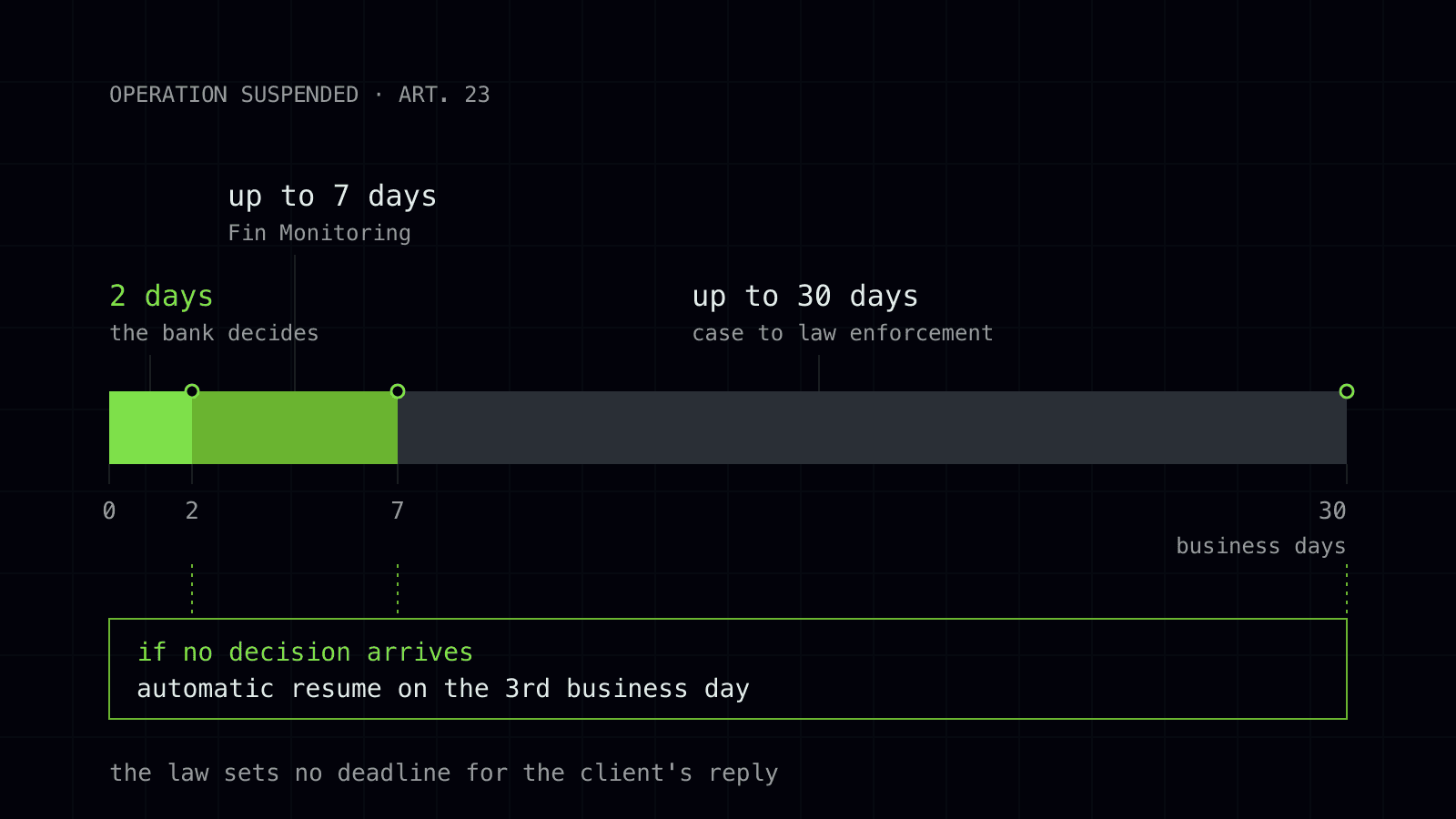
A bank suspends a suspicious transaction on its own for 2 business days, with no advance notice to the client. The State Financial Monitoring Service can extend the suspension to 7 business days. The overall maximum is 30 business days if the materials are passed to law enforcement. These terms are set by Article 23 of Law No. 361-IX.
Reinstatement happens by itself: if no decision arrives within those terms, the transaction resumes automatically on the third business day. You do not need to ask for separate permission, and you cannot speed the term up.
We checked the text of the law and the banks' pages: we found no statutory deadline for a client's reply anywhere, including the widely quoted «10 business days». The term is set by the bank in its own request.
There is no fixed term for reviewing the documents you provide either. In practice it is days rather than hours and depends on the bank. If the date in the letter is approaching and you cannot gather everything in time, it is smarter to send part of it and say when the rest will follow.
What to do if the bank closed the account
Article 15 of Law No. 361-IX is worded as an obligation of the bank, not as its right. If a client fails to provide documents, the bank is required to refuse the transaction, terminate the business relationship where necessary and close the account. It reports the refusal to the State Financial Monitoring Service within one business day.
A closed account does not mean lost money. The balance is returned, usually by transfer to your account at another bank on your written application. It does not happen instantly, and the bank may ask for the account details in writing.
So the first thing after closure is an application to transfer the balance and a written request for the grounds of the decision. The bank's written answer will be useful later: in conversation with your next bank and with a lawyer if it comes to that.
And here the consequences reach beyond one bank. Banks are entitled to share information with each other about people they refused to serve. This is not a blacklist that automatically shuts every door: the law imposes no formal ban on opening an account elsewhere.
But the next bank may ask the same questions at the account-opening stage, and the decision to open is likewise its own. We cannot guarantee you that a new account will be opened: it is not our decision.
What that means in practice. It is smarter to approach a new bank not empty-handed but with a package of source-of-funds documents already assembled. If you are a payroll client somewhere or have a long service history, start there.
And what must never be done under any circumstances: opening an account or a card in the name of a relative or a friend to run transactions through them. That is not a way out of the situation but a separate story with its own consequences for that person, and those are exactly the schemes banks look for first.
The practical conclusion is simple: the plan of «I will sit it out and open an account at another bank» works worse than it seems. It is cheaper to answer the first bank while it is still asking than to explain the same story to the second one with no request at all.
An incomplete reply that explains which documents you lack and why puts you in a better position than silence. AML procedures are built on the client being transparent, and no reply reads as the worst possible signal.
How to avoid a second time
The indicators a bank suspends a transfer on are not invented by the bank. They are listed in Ministry of Finance Order No. 465 of 28.12.2022, in force since 24 February 2023. Among them are payments from unrelated or unknown third parties, transit use of an account and splitting transactions to stay under reporting thresholds.
The payment reference. It has to match what actually happened. A mismatch between the reference and the real movement of funds is precisely what a review latches onto.
Incoming payments from third parties. Regular transfers from various unfamiliar senders, in other words the ordinary picture of P2P, fall straight into the unrelated third parties criterion. That is not an accusation but a description of how your account looks in a report.
Transit behaviour. An account where money arrives and leaves the same day while the balance stays near zero is another criterion in its own right. Large turnover with minimal balances looks the same to a bank regardless of what you actually do.
Splitting. Breaking an amount into several transfers is pointless: it is a separate risk criterion in the same order, not a way around it.
Cryptocurrency is mentioned in the order separately. It is treated as risky when a client insists on settling exclusively or mostly in virtual assets with no clear business or tax reason.
One more thing about the limit people often ask about: 100 thousand hryvnia a month is a memorandum between banks, not a National Bank of Ukraine rule. So different banks apply it differently, and you will not be able to challenge it as unlawful.
When you need a lawyer and when your own reply is enough
Handling it yourself is perfectly realistic when the situation is simple: one transaction suspended or a standard source-of-funds request, the documents in hand, the story explainable in a single page of text. This is the most common case and there is no sense in paying separately for it.
Signs you can manage alone: the request is standard and concerns one transaction, the bank asks about the source of funds in general terms, you have the documents to hand, and the deadline in the letter has not passed.
You need a lawyer when the stakes are different. The bank terminated the relationship and you intend to challenge it. Materials have been passed to law enforcement. The amounts are large and documentary support for the first link is missing. Or you have already been refused by two banks in a row.
Signs in the letter itself after which it is better not to write a reply blind: the bank mentions passing materials on, asks about specific counterparties by name, demands explanations for transactions several years old, or asks for documents you simply cannot have.
A middle option is a one-off consultation with no ongoing representation: show a lawyer your draft reply before you send it. It costs noticeably less than handling the case and removes the crudest mistakes.
What a lawyer will not do: overturn the bank's decision or force it to restore service with a letter. They help with your position and your documents, but the decision still belongs to the bank.
We are an exchange service, not a law firm. What is set out here is a retelling of what the documents say: there are no direct quotations from the law in quotation marks, and we did not check the wording of the articles verbatim. The decision on a specific account is the bank's, and we cannot promise you an outcome. Advice on how to «get around» financial monitoring or hide a transaction is not here and never will be: an attempt to hide is itself a risk criterion under Order No. 465.