
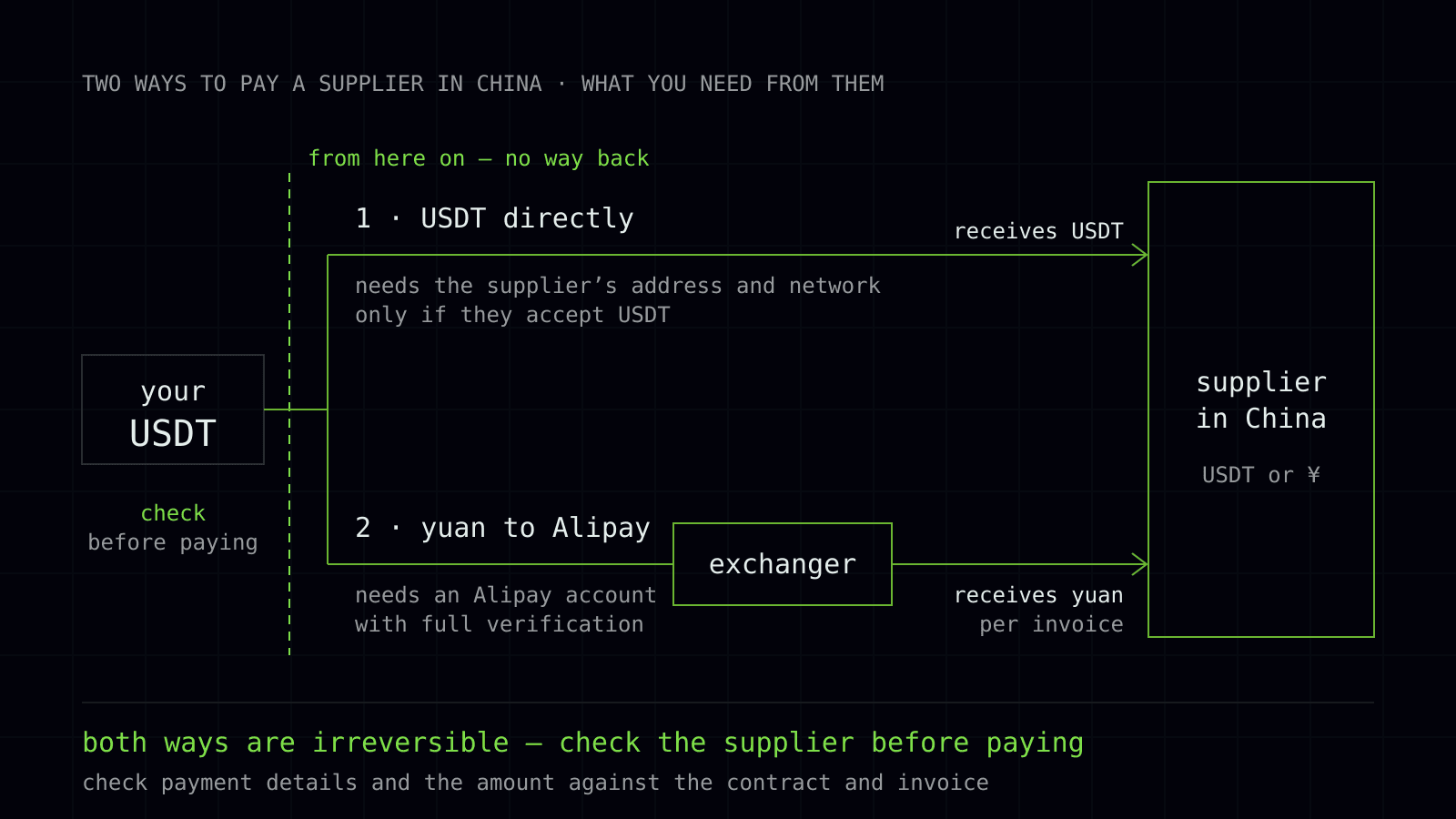
You can pay a supplier in China with USDT in two ways. The first is to send USDT to an address the supplier gives you. The second is to exchange USDT for yuan through an exchange service or a payment agent, and then the supplier receives yuan on Alipay or in a bank account. The first way works only if the supplier accepts crypto; with the second, the supplier gets their own currency, and you can set the amount to match the invoice exactly.
Both ways are irreversible: a USDT transfer cannot be recalled, and a payment credited to Alipay, as Alipay itself warns, cannot be returned. So the main work is done before you pay: check the supplier, match the payment details against the contract and agree on the payment method explicitly.
Our interest, up front: we are an exchange service, and we have a USDT → yuan on Alipay direction — Alipay only, with no payout to a bank account. So below we cover both how this route works with us and where it does not fit.
Why importers pay with USDT
A bank transfer to China usually goes through SWIFT, often via correspondent banks: the timing and the final amount depend on the route, and processing is affected by weekends and public holidays in both countries. A USDT transfer on the network does not depend on bank hours, and its status can be checked by the transaction hash. A detailed comparison of the routes is in the article USDT or SWIFT for a transfer abroad.
But USDT changes only how the money is delivered, not the deal itself. The contract, the invoice, the supplier check and the documents for accounting are needed just as with a bank transfer, and with the documents, as you will see below, it gets even harder.
Option 1: send USDT directly to the supplier
The supplier gives you a wallet address and a network, and you send USDT from your own wallet or from an exchange. There is no intermediary along the way: the money goes from your address to theirs, and the proof of payment is the transaction hash, which is visible in a block explorer.
What to agree on before sending:
- The network. USDT exists on several networks, for example TRC20 and ERC20. The network of the supplier’s address and the network of your transfer must match, otherwise the funds may be lost.
- The amount in USDT. If the invoice is in yuan or dollars and you pay in USDT, put in writing how much USDT settles it. Otherwise the exchange rate difference will have to be sorted out after the payment.
- The address. Take it from the channel the supplier always uses, and after pasting it check the whole address, not just the first and last characters: a lookalike address matches the real one exactly at the start and end. A small test transfer to a new address makes sense only if the supplier confirms receipt and you take the address for the main transfer again from the same channel, not from your wallet history.
The main limitation of this way is not technical: the supplier in China has to accept crypto themselves. If the supplier replies that they do not take USDT, the second way remains.
Option 2: pay yuan to Alipay through an exchange service
You hand over USDT to an exchange service or a payment agent, and it pays the supplier in yuan. Payment agents also transfer to bank accounts in China. On our site, as of 15.10.2026, there is one such direction — a payout to Alipay; this is our route, so keep that in mind as you read on. A payout to a bank account in China is not among our directions.
Alipay is a Chinese payment system. According to Alipay’s own help pages, the detail needed for a transfer to Alipay is the recipient’s account name, that is, their email or phone number. The manager will tell you which recipient details are needed for a payout with us.
Ask the supplier to confirm that their Alipay account has passed full verification. According to Alipay’s help pages, without it the receiving limit is 5,000 yuan a year, and money received on an unverified account cannot be used. This limit is on the recipient’s side, and only the recipient can lift it.
The upside of this way is that it matches the invoice: the supplier receives yuan, and you set the payout amount in yuan. The downside is one more party in the chain: the rate, the amount limits and the payout procedure are set by the exchange service, not by you. The two ways side by side:
What we compare | USDT directly | Yuan to Alipay |
|---|---|---|
What you need from the supplier | wallet address and network | the name of a fully verified Alipay account |
What the supplier receives | USDT | yuan |
Who exchanges USDT for yuan | the supplier, if they need yuan | the exchange service |
Proof of payment | transaction hash | the hash of your transfer and the supplier’s confirmation of receipt |
Main risk | a mistake in the address or network; the supplier does not take USDT | wrong recipient details; limits on the recipient’s account |
How to check the supplier and the invoice
Both a USDT transfer and a payment to Alipay are irreversible, so checking the supplier is the only protection before you pay. Four steps that do not depend on the method:
- The company exists. A Chinese company can be found in the state register of enterprises (National Enterprise Credit Information Publicity System) by its name in Chinese or by the 18-digit code from its business licence. The name in the register must match the name in the contract.
- The recipient is the supplier. If you are asked to send money to an account or address that is not in the name of the company in the contract, ask the company for written confirmation and keep it.
- New payment details are a reason to stop. A message saying the payment details have changed is a common fraudster trick. The UK’s National Crime Agency advises verifying such changes by calling a number you already had, not the number in the message.
- The amount matches the invoice. Exactly as many yuan as the invoice states should be paid out. Give the supplier the invoice number together with the proof of payment, so they can match the payment.
If you found the supplier on a platform with trade protection, keep its rules in mind. Alibaba.com’s blog for sellers states plainly that a transfer outside the platform cancels the trade protection. Paying the supplier directly with USDT or via Alipay is exactly that: payment outside the platform.
Which documents to keep for accounting in Ukraine
In Ukraine, crypto is recognised neither as money nor as currency: that is what the NBU and two other financial regulators wrote in a joint statement on 30 November 2017. The Law “On Virtual Assets” No. 2074-IX has been passed but has not come into force — details in the article on the status of the law. So a payment in USDT does not give you the documents a bank gives.
If you import the goods yourself as a sole proprietor (FOP) or a company, this matters at customs. The Customs Code (Art. 53, version of 17.09.2026) lists, among the documents confirming customs value, the contract, the invoice and, if the invoice has been paid, bank payment documents. The same article also names other payment or accounting documents, where available, and if there are discrepancies, customs may request additional ones.
A USDT transfer does not produce a bank payment document. Whether customs and your accounting department will accept a different chain of documents is for them to decide, not the exchange service. Discuss this — and how such a payment fits with currency control rules — with an accountant, a lawyer or a customs broker before the first payment, not after it.
What to keep in any case:
- the contract or confirmed purchase order, and the invoice with the amount in yuan and the supplier’s name;
- the exchange order number, a link to its page and the hash of your USDT transfer;
- the supplier’s written confirmation that the money for this invoice has been received;
- documents showing where your USDT came from. An exchange service may check the origin of coins, and for a large amount, documents may be requested under the law. How to gather them is covered in the article on source of funds.
How an order works with us
You create the order on the page for exchanging Tether for yuan on Alipay. Below is what the form and the order page show as of 15.10.2026. The payout is made by an operator, not by a machine.
- Amount. Choose the network — Tether TRC20 or ERC20 — and enter an amount: either the USDT you give or the yuan from the invoice in the “You get” field. The form works out the other figure itself. The amount limits, minimum and maximum in USDT, are shown under the order button.
- Details. In the “Recipient details” block, the form asks only for your Telegram username. Have the supplier’s Alipay details and the invoice at hand in advance: the rate is held for 5 minutes after the order is created and is then recalculated.
- USDT transfer. After you create the order, the manager writes to you on Telegram to agree on the exchange. Where and when to send the USDT is shown on the order page — the address, the network and the exact amount — and confirmed by the manager. The network fee is paid by the sender, and the amount must match to the last digit.
- Payout. The operator pays out the yuan to the recipient’s Alipay, and the status is visible on the same order page. Ask the supplier for confirmation of receipt as well.
The amount in the “You get” field is yuan at the order rate, with the exchange service’s margin already built into the rate; as of 15.10.2026, there is no fixed payout fee in this direction. We do not state a payout time: a person makes the payout, and the time depends, among other things, on agreeing it with you. If you do not have USDT yet, here is how to buy USDT in Ukraine.