To get pounds into a UK bank account, you sell USDT for GBP and receive a bank transfer to an account in your own name. There are three realistic routes: a UK-registered exchange that pays out by Faster Payments; P2P, where a buyer pays you directly; or an exchanger whose manager quotes the terms. Compare them by one number: pounds that reached your account divided by USDT that left your wallet.
The market rate matters less than three practical things: which network your USDT is on, whether your bank accepts money linked to crypto, and how much checking you are ready for. Below are the steps for each route, what UK banks say on their own pages as of 16.10.2026, and what HMRC expects.
Our interest, said up front: we are MW Exchange, an exchanger, and we also buy USDT for pounds — by hand, through a manager. We have no office in the UK, and our route gets the same scrutiny below as the other two.
What is the best way to convert USDT to GBP?
Each route starts the same way — USDT leaves your wallet — and differs in the middle. On an exchange you sell to the market and withdraw pounds to yourself. In P2P a stranger pays you by bank transfer while the platform holds your USDT. With an exchanger, a manager agrees the rate and payout with you before you send anything.
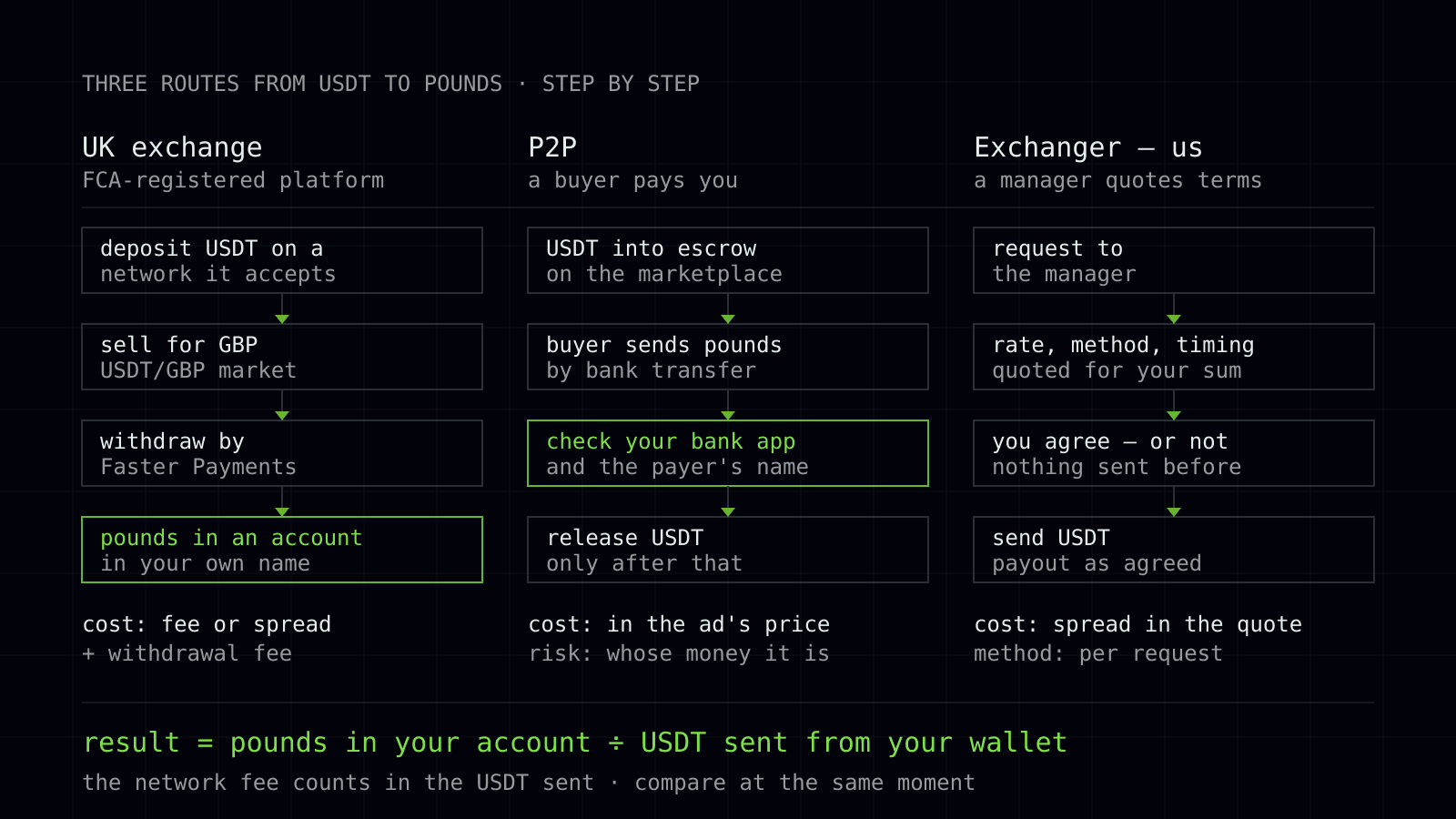
There is no single winner. An exchange is the most direct path to a UK account, P2P can show a better price but puts the risk on your bank account, and an exchanger agrees the result before the coins move.
How do you sell USDT for pounds on a UK exchange?
Here a UK exchange means a platform registered with the Financial Conduct Authority (FCA) that lists a USDT/GBP market and pays out by Faster Payments. On 16.10.2026 the FCA register listed, among others, Payward Ltd (Kraken) and CB Payments Ltd (Coinbase), and public market data of both showed USDT/GBP trading; whether your account can use it, check after you log in.
- Verify your account (KYC): an ID document and usually a selfie. Under HMRC guidance updated on 01.01.2026, platforms also collect your National Insurance number or Unique Taxpayer Reference.
- Pass the checks FCA rules require for UK customers: a questionnaire on crypto risks and, for first-time customers, a 24-hour cooling-off period. Do it before the day you need the money.
- Deposit USDT on a network the platform accepts. On 16.10.2026 Coinbase's public data listed USDT on Ethereum and other networks but not on Tron; Kraken lists both Tron and Ethereum.
- Sell for GBP and withdraw by Faster Payments to an account in your own name: Kraken, for example, rejects withdrawals to anyone else.
The cost sits in the trading fee or spread, the withdrawal fee and the network fee for your deposit. Kraken's published figures on 16.10.2026: 0.20% on stablecoin-to-currency pairs at the entry tier of Kraken Pro, 1% plus a spread in the simple app, £1.95 per GBP withdrawal with a £5 minimum. Coinbase builds the spread into the simple sell price and shows it on the preview screen.
If the USDT comes from your own wallet, expect a check that the wallet is yours. For UK clients, Kraken asks for it on deposits above 1,000 euros from a private wallet: a one-click self-attestation or a small test transfer.
FCA registration is an anti-money-laundering registration, not an endorsement: the register itself says protection by the Financial Ombudsman Service or the FSCS is unlikely for most cryptoassets. The FCA's full regime for crypto firms is due to start on 25.10.2027.
Is it safe to sell USDT on P2P in the UK?
P2P is a sale to another person through a marketplace. You place USDT on the platform, the buyer sends pounds by bank transfer, and the platform holds your USDT in escrow until you confirm the payment. The price is in the ad; on top you pay the network fee for moving USDT onto the platform.
The risk is in where the pounds come from. Since 7 October 2024, UK payment firms must reimburse most victims of authorised push payment scams, and the Payment Systems Regulator splits that cost 50:50 between the victim's bank and the receiving bank. If a buyer pays you with a victim's money, your bank shares the bill, so it has a direct reason to look at payments from strangers.
What can follow is a held payment, a closed account and a fraud-prevention marker: Cifas files money muling under "misuse of facility" and keeps such markers for up to six years.
If you still choose P2P:
- Check the platform on the FCA register before you deposit.
- Release USDT only when the money is visible in your own banking app, not on a screenshot.
- Compare the payer's name with the buyer's name on the order; refuse payment from anyone else.
- Keep the deal on the platform: a payment arranged outside it is not covered by its escrow.
Can an exchanger pay you pounds for USDT?
This is our route, so we have a direct interest. Our USDT to GBP page has no live rate and no order form: a manager handles the exchange. After your request, the manager quotes the rate, the payout method and place, and the timing for your amount, and says which payout options exist. A payout to a UK bank account is not promised in advance.
- Message the manager in the chat on that page.
- Give the amount, the network (TRC20 or ERC20) and where you need the pounds.
- Get the terms — rate, method and place, timing, order of settlement — and accept or decline. Nothing has to be sent before you agree.
- Send USDT to the address the manager gave you, on the agreed network.
The quoted rate includes our margin, the spread: it covers the manual work and the risk that the pound moves during the deal. The rate may depend on the amount, so ask for the rate for your exact sum. An exchanger may check where the coins came from; for a large amount, the law may require documents.
Which route leaves you with more pounds?
Use one formula for all three: pounds that reached your account divided by USDT that left your wallet, network fee included. Costs sit in different places — the rate, a trading fee, a withdrawal fee — so only this number compares them. Fixed fees weigh more on small sums: £1.95 is 2.6% of £75 but 0.26% of £750.
Route | What you need | Where the cost sits | How the pounds arrive |
|---|---|---|---|
UK exchange | verified account, FCA questionnaire, a network the platform accepts | trading fee or spread, withdrawal fee, network fee | Faster Payments to an account in your name |
P2P | verified account on the marketplace | in the ad's price, plus the network fee | bank transfer from the buyer |
Exchanger via a manager (us) | USDT in a wallet, a chat with the manager | spread in the quoted rate, network fee | the method the manager names for your request |
To see what a route cost you, divide your final rate by the market USDT/GBP price at the same moment, subtract one and multiply by 100. A negative result is the percentage you paid for the route.
Will a UK bank accept money from selling crypto?
Most published UK bank limits are on money going to crypto platforms. As of 16.10.2026, Santander caps payments to crypto exchanges at £1,000 per payment and £3,000 in a rolling 30 days; NatWest at £1,000 a day and £5,000 in 30 days, since 16 March 2023; Chase UK allows them only to your own account at an FCA-registered UK firm, up to £1,000 a day and £5,000 in 30 days.
NatWest's page adds that there is no block or limit on payments made to you. Starling is the exception: its help centre says it no longer supports the buying and selling of crypto by debit card or bank transfer. If you bank with Starling, ask the bank before you sell.
Every UK bank must also monitor transactions under the Money Laundering Regulations 2017 and, where necessary, look at the source of funds. There is no official list of documents for crypto sales. What helps is a paper trail made at the time: the platform's statement of the sale and withdrawal, the transaction ID (TxID), and an invoice or contract if the USDT was payment for your work.
What should you check before sending USDT?
USDT runs on several networks; the common ones are Tron (TRC20, addresses start with T) and Ethereum (ERC20, addresses start with 0x). The receiving side names the network, and a transfer on the wrong one can be lost. The sender pays the network fee: by our measurement on 19.09.2026, a USDT transfer cost about $2.17 on Tron and about $0.28 on Ethereum — the state of the day, not a rule.
On Tron the fee is paid in TRX, so keep 15–20 TRX in the wallet; details are in USDT wallet: TRC20 and ERC20. If you hold USDC, the routes are the same; how the coins differ is in USDT vs USDC.
Before the coins leave your wallet:
- The network and address, confirmed by the receiving side.
- TRX or ETH in the wallet for the network fee.
- Records: where the USDT came from, statements, TxIDs, the value in pounds on each date.
- The terms in writing, not just in a call.
Do you pay tax when you convert USDT to GBP?
HMRC treats selling tokens for money as a disposal, so Capital Gains Tax may be due on the gain, counted in pounds: what you received minus what the USDT cost you, less allowable fees. For 2026/27 the tax-free allowance is £3,000, and the rates are 18% within the basic-rate band and 24% above it (gov.uk, checked on 16.10.2026).
If the USDT was payment for your work, it is income when you receive it, and HMRC's guidance says Capital Gains Tax then applies only to the gain made after that. HMRC expects you to keep your own records of each transaction: a platform's report is not a tax calculation.
HMRC's notes to the 2025/26 Self Assessment capital gains pages also ask you to fill them in when disposals total more than £50,000, even if the gain is small. This is an overview, not tax advice: how the rules apply to you is a question for a UK tax adviser.