

Framework law «On Virtual Assets» No. 2074-IX was signed on 17 February 2022, but it has not entered into force. Under its transitional provisions it starts working only on the day the law amending the Tax Code takes effect.
Those amendments do not exist: draft law No. 10225-d passed its first reading as a basis on 3 September 2025 and has not moved since. So today income from cryptocurrency falls under the general rules of the Tax Code, not under a special regime.
Hence the confusion of «crypto was legalised, but nothing changed». Both halves of the phrase are true. The law was passed and signed, and at the same time not one word of it is in force.
What a framework law is and why signed does not mean in force
A framework law describes the structure, not the detail. It introduces definitions, allocates powers, names the market participants and sets out who answers for what. The specific figures, rates and procedures live in other acts.
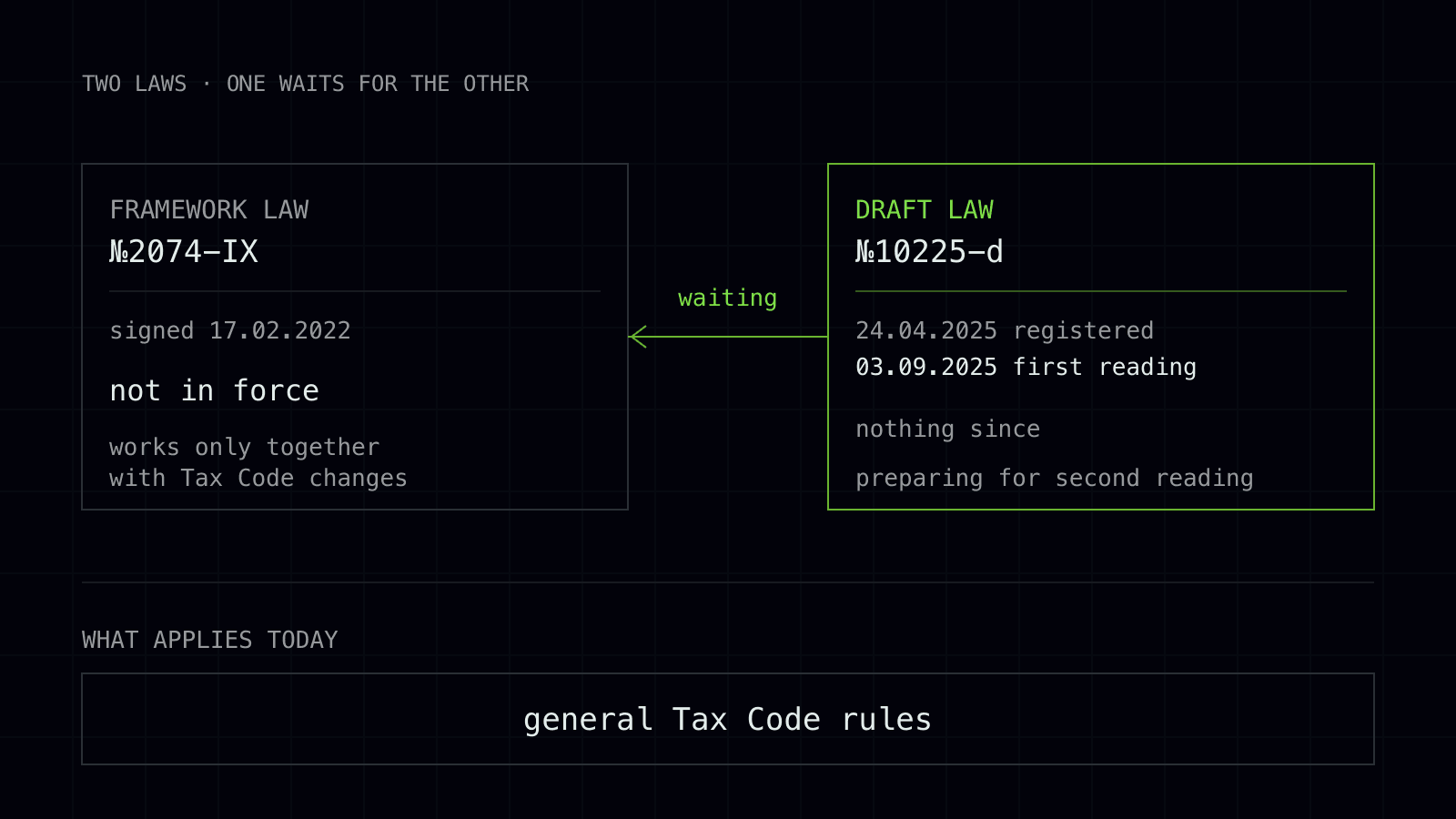
Signing and entry into force are two different events. Signing completes the passage: the text becomes law. Entry into force sets the moment its provisions start to apply.
The legislator can postpone that moment or make it depend on another event. The second option is what applies to No. 2074-IX: its transitional provisions tie entry into force to the day the law amending the Tax Code starts working.
No tax amendments, no operative framework law. The logic is clear: the framework describes the market but says nothing about how tax is paid on it.
Launching a market with no tax rules would create a sector operating in a vacuum, and the legislator deliberately avoided that.
The law's page in the register carries the note «has not entered into force». That is not a database glitch or a stale flag: as of 21 August 2026 it is accurate.
Two laws and why one waits for the other
No. 2074-IX introduces the very concept of a virtual asset, allocates powers between regulators and sets out requirements for providers of services connected with the circulation of virtual assets.
What it does not contain is tax provisions. Taxation lives in the Tax Code, and without amendments to the code the framework remains a structure with nothing to rest on.
This is not a technical delay and not a question of secondary regulation. Secondary acts can be written after the start; here it is the start itself that is at stake.
Until the tax amendments are passed and take effect, the framework law legally does not work. Not «works in part» and not «works in the part unrelated to tax»: it does not work at all.
The practical consequence is simple. Neither the service provider status nor any special rules for virtual asset transactions apply right now.
Everything touching your income is governed by the same provisions as any other income of an individual.
How the 2022 framework law differs from what the draft proposes
These are two different kinds of document, and they get mixed up constantly. No. 2074-IX describes the market: who counts as a service provider, what counts as a virtual asset, which authorities supervise circulation.
No. 10225-d is a set of amendments to the Tax Code. It does not describe the market; it answers a single question: how much to pay and on what.
Hence the different audiences. The framework law addresses first of all companies working with virtual assets. The tax amendments affect both companies and every person who has sold a coin.
The dates in these documents are also different in nature. No. 2074-IX has a signing date, 17 February 2022, but no date of entry into force: that was made dependent on the tax law.
No. 10225-d has not even been passed. It stopped after the first reading on 3 September 2025.
And the link between them runs one way. The tax amendments, if passed, will launch the framework. The framework cannot launch itself, however long it has been since signing.
We describe the content of the draft as it stands in the first-reading text. The final text being prepared for the second reading is not available, and we do not know how far it differs.
What entry into force would give an ordinary person
The honest answer: it cannot be stated precisely, because the key parameters sit in a draft that has not been passed and will still change. But the direction of the changes can be described.
First, there would be certainty about the tax base. Today the State Tax Service proceeds from the whole amount received being taxed, while most lawyers calculate from profit.
There is no direct provision in the code that settles this dispute, and that is exactly what the tax amendments are meant to add. Until it exists, the disagreement is resolved not by law but by whose position you chose.
Second, service providers would gain legal status. That is what affects banks: once legislation recognises a regulated market participant, a transaction with it stops being a transaction of unknown nature for the bank.
Third, there would be an answer on swapping one coin for another. Right now there is no official answer at all, and that is not a figure of speech: we found no direct clarification.
What entry into force would not give. It will not cancel the duty to declare income and will not make transactions anonymous. The framework is about record-keeping and supervision, not about release from them.
What the Verkhovna Rada card shows
The timeline of No. 10225-d on the parliament's card is short: registered 24 April 2025, committee opinion 25 April 2025, adopted as a basis in the first reading on 3 September 2025, status «being prepared for the second reading».
There is not a single event on the card after September 2025. We checked this directly on 21 August 2026.
A first reading is agreement with the idea, not with the text. Between the first and second readings amendments come in by the hundred, and it is at this stage that rates, thresholds and exemptions change.
A draft adopted as a basis is not a law and creates no obligations whatsoever. It is also no guarantee that it will be passed at all.
The card on the parliament's site is the most reliable source of status available to a reader. A news item can run ahead of the event or relay someone else's statement; the card shows registered actions.
What the card does not show is intentions. It records what happened, which is exactly why it is convenient for checking the news against: if the event took place, it is there.
What the status «being prepared for the second reading» means
Formally it means one thing: the text sits with the committee, which collects amendments from members of parliament and prepares them for the floor.
Timing at this stage is fluid. The date of the second reading is set by the session agenda; it does not arrive automatically a certain period after the first.
So a draft can sit in this status for years with no registered event at all. That is not a procedural failure: adoption as a basis does not oblige parliament to return to the text within any particular period.
In the case of No. 10225-d, almost a year of an empty card separates the first reading from today. For comparison, about four months passed from registration to the first reading.
What follows for the reader: «being prepared» is not a forecast. The word describes a stage, not a speed, and carries no promise of completion.
And one misunderstanding worth clearing up. The status «being prepared for the second reading» does not mean the first-reading text applies in any part. Nothing applies.
The postponement to autumn 2026 and what is wrong with it
Adoption has been pushed back at least to the autumn. This comes from a report of 31 July 2026, which names the reason: the National Bank of Ukraine and the National Securities and Stock Market Commission failed to agree on the regulator's powers.
That reason is a member of parliament's position, not an established fact. We found no official joint statement from the regulators about a disagreement.
We word it this way deliberately. The explanation from a member of parliament may be accurate, but a reader cannot verify it, and neither could we.
The difference between «the regulators are in dispute» and «a member of parliament said the regulators are in dispute» is the difference between a fact and a retelling.
The date itself deserves the same caution. «Autumn 2026» is an expectation, not a slot on a schedule. The draft has already stood still for almost a year after its first reading.
Who will be the regulator: the National Bank or the securities commission
The question of the regulator looks bureaucratic until you see what depends on it. The regulator writes the rules, issues permits, sets reporting requirements and decides who is allowed to operate on the market at all.
The logic of the split follows from the nature of the assets. Some virtual assets are closer to a payment instrument, and that is the National Bank's field. Others are closer in economic substance to securities, and that is the securities commission's field.
The problem is that the line between those groups is not self-evident, and the classification of a particular asset decides whose supervision it falls under. So the dispute about powers is really a dispute about classification.
It cannot be settled quickly, not least because the split has to be fixed in law rather than in a working arrangement: the rights of third parties depend on it.
What exactly the regulators failed to divide up we cannot say. We found no public account of either side's position, and the only explanation in the news comes from a member of parliament.
Describing someone else's conflict from a single retelling means passing off one version as the balance of forces. For the reader there is one practical conclusion: until the regulator is settled, there will be no secondary rules for the market to run on.
What draft law No. 10225-d proposes
In the first-reading text the general rate is the same one that applies today: 18% personal income tax plus 5% military levy. The draft creates no special preferential regime «forever».
It proposes two temporary mechanisms, and those are what most often make the headlines.
The first is a reduced 5% rate on profit from converting virtual assets into fiat during the first year after the law enters into force. That is a window, not a permanent regime.
The second is a one-off transitional declaration of previously acquired cryptocurrency at 5% personal income tax plus 5% military levy. The mechanism is aimed at those who bought coins before the rules existed.
Another idea in the draft: taxing conversion into fiat specifically, rather than every swap of one coin for another. Today there is no official answer to that question at all, and the draft does not close the gap, because it has not been passed.
Read more: in the article on crypto-to-crypto swaps.
What happens to transactions already made
As a general rule, a law that enters into force looks forward. Income received before that moment stays within the rules that applied when it arose.
In practice that means a sale made in 2025 or 2026 is declared under the current provisions: 18% plus 5%. A special regime appearing later does not rewrite that.
So waiting for the law is no reason to postpone a return. An obligation for a past period arises under the rules of that past period, not under rules that may appear one day.
The exception many people are counting on is indeed in the draft: a one-off transitional declaration of previously acquired crypto. But that is a provision of an unpassed text in its first-reading version.
There is nothing to base today's decision on. A provision that does not exist cannot be a relief you plan a sale around.
One thing works under any scenario: proof of the purchase price and date. It will be needed both under the current rules and under transitional declaration, if that is ever passed.
What to do now, while there is no law
Work from the rules in force, not from the draft. Income from selling cryptocurrency is declared under the general provisions of the code: 18% personal income tax plus 5% military levy. A breakdown of the rate is in the article on the military levy.
Keep proof of the purchase price. Statements, transaction history, receipts: without documents none of the possible scenarios works.
Do not plan a sale around the 5% rate. The provision does not exist, the date of its appearance is unknown, and the first-reading text is not final.
Do not move assets «to fit the future regime». While neither the range of participants nor the requirements on them is known, shifting funds in advance is done on an assumption, not on a rule.
Follow the draft's card, not the news. There is plenty of news about «preferential 5%», and not a single event on the card since September 2025. The gap between the number of publications and the number of events is telling.
And check the date on any material about the status of the law. An article about a draft law goes stale faster than an article about a rate: it has no stable part.
Why the draft's numbers cannot be treated as yours
All the figures above are the first-reading text. By the second reading they may change, disappear or acquire conditions the text does not contain now.
The second caveat concerns sources. Publications about the preferential 5% look numerous, but they all retell the same draft text.
Ten articles about one provision are one document, not ten confirmations. The number of links in search adds nothing to reliability here.
We too did not check these provisions against the primary text prepared for the second reading: it is not available. So we present them as the content of the draft in its first-reading version, and nothing more.
What follows in practice. Income from selling cryptocurrency is declared today under the general rules of the code, and the rate is 18% plus 5%. We cover the calculation in more detail in the article on which amount the tax is calculated from.
And a plain disclaimer about us. We are an exchange service, not a tax adviser. We relay what is in public sources and name where it comes from.
The decision on how exactly to declare a particular income belongs to an accountant who sees your situation, or to the tax authority. Our part of the job is to show where the verified ends and the retelling begins.