

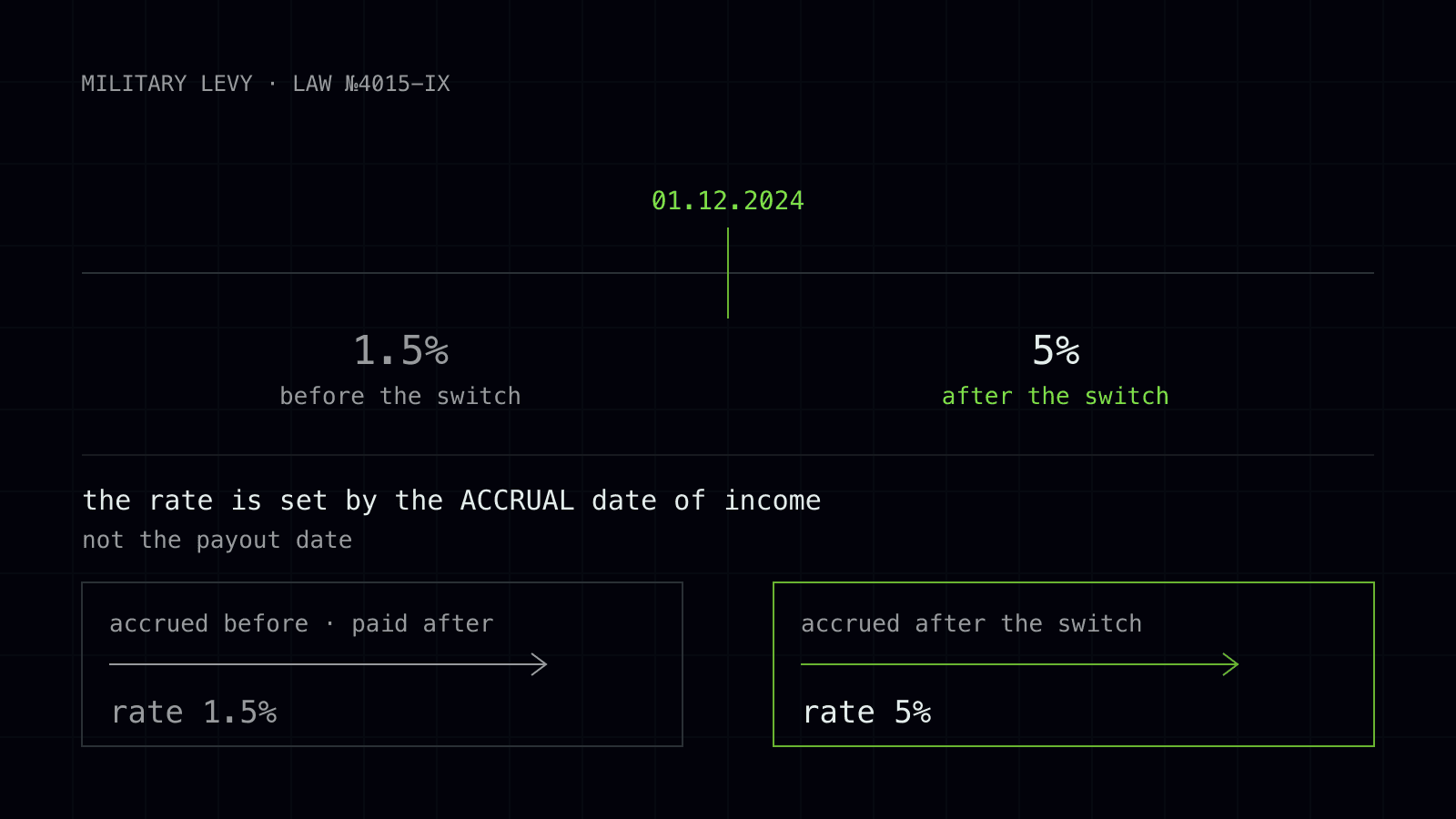
For an individual, the military levy rate is currently 5%. It has applied since 1 December 2024 and was introduced by Law No. 4015-IX. The old 1.5% rate has not disappeared, but it applies only to income accrued before that date.
What sets the rate is the date the income was accrued, not the date the money actually reached the account. So a calculator built on one and a half percent will understate the levy on 2025 or 2026 income; it is not an alternative way of counting.
The difference looks small until you put it on a sum. On income of 1,000 dollars it is 50 dollars of levy instead of 15. Together with personal income tax at 18% the total load is 23%, not the 19.5% that older articles still use.
Who pays the military levy and on what
The military levy is paid by individuals on income subject to personal income tax. The levy has no separate base of its own: it is calculated from the same amount and under the same base rules as personal income tax.
That is exactly why the formula reads «18% plus 5%». Two rates on one base, not two separate calculations added up afterwards. If you know what personal income tax is charged on, you know the levy base as well.
How the payment works depends on who pays out the income. When there is a tax agent, an employer or a company client, it withholds both the tax and the levy at the moment of payment. The person receives a net amount and counts nothing.
When there is no tax agent, the duty passes to the recipient. That is the case with income from a foreign source or a payment from another individual: the person reports such income in the annual return and pays both amounts personally.
Income from selling cryptocurrency almost always falls into the second group. So for a crypto holder the question «how much will be withheld» usually does not arise at all: the counting is on you.
The levy rate also does not depend on how many transactions a person made during the year. One return is filed for the whole year, and the income appears in it as a total on the relevant line, not as a separate entry per sale.
A note on the limits of our checking. Everything above concerns an ordinary individual. For certain categories of payers, sole proprietors on the single tax first of all, the structure is different and we did not verify it. There is a separate section on that at the end.
What Law No. 4015-IX actually changed
The law raised the military levy on individual income from 1.5% to 5% and fixed the date from which the new rate applies: 1 December 2024. The levy itself is not new; only the number changed.
What did not change matters more than what did. The range of payers, withholding by a tax agent, reporting, payment deadlines, the link to personal income tax rules: all of it stayed the same. The law rewrote the rate, not the mechanism.
The practical consequence: any article written before December 2024 remains usable on method and unusable on the number. That is not a reason to throw out older material, it is a reason to read it selectively.
A plain disclaimer belongs here, and better right away. We confirmed the 5% rate against secondary sources and a State Tax Service page, but did not check it against the primary text of the Tax Code (clause 16-1 of subsection 10, section XX). The code page returned only metadata on request.
The number is consistent across every source we saw, and we have no grounds to doubt it. Still, it is more honest to show the verification chain than to hide it: the difference between «checked against the code» and «checked against retellings of the code» is real.
How the 5% rate applies to different kinds of income
The rate is the same for all individual income subject to personal income tax. The difference is not in the number but in who does the counting, when the obligation arises and which line of the return the income lands on.
Income from a tax agent, a salary or a fee under a contract with a company, is closed out without the person's involvement. The agent withheld, remitted and reported. No separate action is needed from the recipient.
Income with no tax agent is reported by the person. This covers payments from abroad, settlements between individuals and income from transactions where the other side is not a Ukrainian tax agent.
The State Tax Service classifies crypto income in two ways. If the paying source is foreign, it is foreign income. If the payment came from a resident, it is other income. The classification does not affect the rate: 18% plus 5% either way. It affects the line of the return and whether the question of tax paid abroad comes up.
A second disclaimer. We read the State Tax Service clarifications behind this classification through regional tax office pages. We could not verify the dates of those clarifications: the main site returned an access error. We are relaying the classification, not backing it with a date.
Accrual or payment: which date to count by
The transition rule is simple: look at the date the income was accrued. If it was accrued before 1 December 2024, 1.5% applies even when the payment came later. If it was accrued on or after 1 December 2024, 5% applies, and the payment date makes no difference.
The logic here is not an accounting whim. Accrual is the moment the income is recognised as the person's. Payment can lag by months, be split into parts or happen by court order. Tying the rate to accrual keeps it unambiguous where payment is stretched out.
First example. A fee was accrued in November 2024 and paid in January 2025. The levy is calculated at 1.5%, because accrual came before the transition, and the January payment does not change that.
Second example. Income was accrued in December 2024 and the person received the money that same month. The rate is already 5%: accrual fell in the first month of the new rule.
Third example, the most common for the reader of this article. A person sold cryptocurrency in 2025 or 2026. Both dates, accrual and receipt, sit well past the transition. The question is closed: 5%.
This rule stays alive mainly for recalculations: wage arrears for 2024, a payment under a court ruling, an additional charge for an old period. For everyone else the transition is long behind.
What to do if you counted at the old rate
First things first: an underpayment does not go away by itself. The fact that an outdated search result caused it is no ground for release from the obligation. The rate is set by law, not by the source a person learned it from.
How to spot the error. Recount the amount at 23% and compare it with the figure in the return you filed. If the calculation used 19.5%, the gap shows up at once: the underpayment equals 3.5% of the base.
If the return has not been filed yet, this is the easiest case. Recount at 5% before filing and the matter closes with no extra procedures at all.
If the return has already been filed with an understated amount, the code provides a correction mechanism. We did not verify the exact procedure, deadlines or possible penalties, so we do not put numbers on them. Naming penalty percentages off the top of your head in an article about taxes would repeat the very mistake this article is about.
This is exactly the case for an accountant or a tax adviser. Not because the arithmetic is hard, but because the consequences depend on when and how the error was found, and who found it first.
What you definitely should not do is carry the underpayment «over to next year». The obligation is tied to the tax period in which the income arose, and moving it into another return on your own creates a second error on top of the first.
Why 1.5% is still all over search
Because it is not a different case, it is a different period. Material quoting 1.5% was written before December 2024 and simply never updated after the law changed. Such articles often show no publication date, and the text sounds confident, so readers take it as current.
The problem is wider than small websites. Outdated material quoting 1.5% sits on the sites of large consulting firms and in some of the tax authority's own crypto clarifications.
That calls for selective reading: such a clarification can be trusted on how income is classified, but not on the rate. The reasoning about whether income is foreign or other survived the rate change untouched. The number next to it did not survive at all.
There are three typical places where the old rate lives longest: archived articles from law and consulting firms, online calculators with the formula hard-coded, and explainers about crypto written before December 2024.
How to tell current material from outdated
The first filter is a mention of the transition date. Material written after the change almost always names 1 December 2024, because without that date there is no way to explain what 1.5% applies to and what 5% applies to.
Hence the rule. If a text says 1.5% and says nothing at all about the transition, it was written before the change. Read it as a description of method and substitute the current rate.
The second filter is the bottom-line number. Current material puts the total load at 23%. A text that totals 19.5% describes the period before December 2024, even with no date anywhere in it.
The third filter is a caveat about sole proprietors. Material written after the change almost always separates the rate for an ordinary individual from the rates for entrepreneurs, because after 2024 those are different numbers.
The publication date on its own is a weak signal. It is often missing, and where it exists it frequently shows the last technical update of the page rather than the date the text was written.
A trap of its own is half-updated material. It happens that the rate in the text was corrected while the worked example below kept the old number. Look not at the first mention of the rate but at the arithmetic in the example: that shows which figure the text really counts by.
How this applies to income from selling cryptocurrency
Income from cryptocurrency transactions is taxed under the general rules: personal income tax at 18% plus the military levy at 5%, 23% in total. Current legislation has no separate rates for crypto.
Hence there are no discounts for how long you held. The current rules do not distinguish a coin bought last year from a coin bought last week: they simply contain no special construction for this income.
The reduced 5% rate that appears in the news exists only in draft law No. 10225-d, which has not been passed. There is nothing to count by it today: the rule does not exist. We write about the status of the law in a separate article.
What exactly you multiply by 23% is a separate and far sharper question. Under State Tax Service clarifications the base is the entire amount received from the transaction, with no deduction for the purchase cost. In most publications lawyers calculate the tax on net profit.
There is no direct rule in the code that would settle this dispute, and on a swap of a stablecoin into fiat the difference runs to multiples. The 23% rate raises no doubts; the base does. A breakdown of that disagreement is in the article on which amount the tax is calculated from.
Swapping one coin for another without cashing out into hryvnia stands apart. We found no direct official clarification on whether taxable income arises there. That is an honest «unknown», not a hidden answer.
When to pay and to which details
The military levy on such income goes together with personal income tax through the annual property and income return. Individuals file no separate reporting on the levy itself.
For 2025 the deadlines were as follows: the return by 30 April 2026, payment of the tax and the levy by 1 August 2026 (clause 179.7 of the Tax Code). That campaign is already over.
The budget classification codes differ: 11010500 for personal income tax and 11011001 for the military levy. These are two separate payments, and paying the whole sum under one code creates an overpayment on one and an underpayment on the other.
The nearest deadline for the reader is the return for 2026. Under the general rule that is 30 April 2027, but this is our calculation, not a source: there is no official page for the 2027 campaign yet. It is worth confirming the date before filing.
We walk through the filing procedure itself in the Electronic Cabinet in a step-by-step article on declaring crypto income.
Why sole proprietors on the single tax are treated separately here
For a sole proprietor on the simplified system the military levy rates differ from those for an ordinary individual. This is the case where carrying a number over from this article means counting it wrong.
We did not check that case and so do not describe its substance. The divergence is not in the details but in the whole construction: a different base, a different frequency, a different link to the group.
If crypto income passes through business activity, you need an accountant who can see your group, turnover and activity codes. An article written for individuals does not work here even as a rough guide.
And the general disclaimer we repeat in every text about taxes: we are an exchange service, not a tax adviser. We write what is known and where it comes from, and we do not give advice that only a specialist who knows your case can give.
The decision on how to file the return is made by the taxpayer and checked by the tax authority. What we can do is show where the number came from and exactly where the verified part ends.