

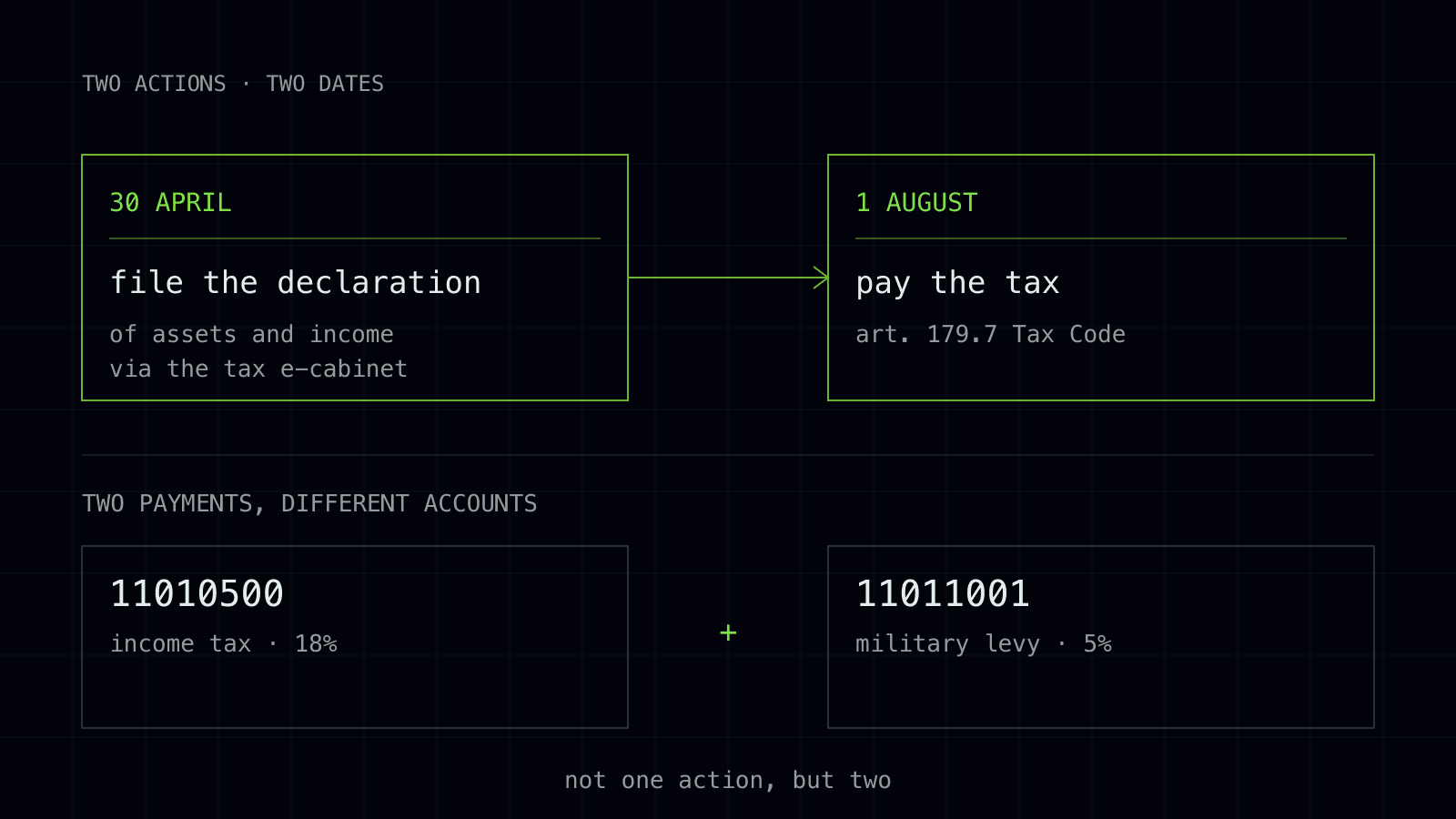
The property and income tax return is filed by 30 April of the year following the reporting year. The personal income tax and military levy assessed on it are paid by 1 August of the same year (clause 179.7 of the Tax Code). Filing goes through the Taxpayer Electronic Cabinet on the State Tax Service site. The budget classification codes for payment are 11010500 for personal income tax and 11011001 for the military levy.
The nearest deadline for you is the 2026 return, due by 30 April 2027. One caveat straight away: that is a calculation from the general rule, not a citation of a source.
The State Tax Service has not yet published an official page for the 2027 filing season. Before you file, it is worth checking the date on tax.gov.ua: deadlines are sometimes shifted by separate decisions.
Who is required to file a return
Anyone who received income from which nobody withheld tax. If during the year you sold cryptocurrency and received money for it, the obligation is yours.
There is no minimum threshold below which this type of income need not be declared. A small amount does not create an exemption, it creates a small tax bill.
Residency matters more here than citizenship. A Ukrainian tax resident declares income regardless of where it was earned, including on foreign exchanges.
A separate case is a long stay abroad. Resident status is determined not by a passport but by a set of criteria, and in that situation you cannot do without professional advice.
How to pay tax on cryptocurrency: the procedure
The procedure is the same for any amount and has four steps: gather your history, calculate the income for the year, file the return by 30 April, pay in two payments by 1 August.
Step one, the history. Export every transaction for the reporting year: from the exchange, from exchange services, plus bank statements for the accounts that received hryvnia.
Step two, the calculation. Income is calculated in hryvnia at the rate on the date of each transaction, not at the year-end rate. That is exactly why you need the date of every sale, not just the amount.
Step three, the filing. Through the Taxpayer Electronic Cabinet, with a qualified electronic signature. The form is the property and income tax return.
Step four, the payment. Two separate payments by 1 August: personal income tax under code 11010500 and the military levy under code 11011001.
What this procedure does not settle automatically is the exact figure to put on the return. That runs into the dispute over the tax base, and nobody will close it for you.
What the deadlines are and where to pay
Two dates, and they are different. The thirtieth of April is the filing deadline, not the payment deadline. The first of August is the deadline for paying what you yourself assessed on that return.
Three months sit between them, and that gap exists precisely so there is time to find the money for the tax.
Payment details are taken from your local tax office's page, not from memory: the accounts are tied to the territorial body.
The part that does not change is the budget revenue classification codes: 11010500 (personal income tax on income not received from tax agents) and 11011001 (military levy). Two payments, not one: the tax and the levy go to different accounts.
Foreign income or other income: what it depends on
Income from cryptocurrency transactions is included in total annual taxable income under one of two headings. As foreign income, if the source of payment is foreign. As other income, if the payment came from a Ukrainian resident. That is the wording of the State Tax Service guidance itself.
In practice it all comes down to one question: who sent you the money. Sold on a foreign exchange and withdrew from there to your card, and the source of payment is foreign.
Received hryvnia from a Ukrainian exchange service or from a resident in a P2P deal, and it is other income. The rate is the same either way; only the lines on the return differ.
We could not verify the dates of this guidance: a direct request to tax.gov.ua returns a 403. The classification itself is confirmed by several regional State Tax Service pages.
But it cannot be presented as a provision of the Tax Code: there is no direct provision on taxing crypto income in the Code at all.
What a tax rebate is and what it has to do with this
The question comes up for almost everyone facing a return for the first time, and usually because of confused wording. A tax rebate and the deduction of crypto purchase costs are different mechanisms, and the second does not follow from the first.
A tax rebate is a separate instrument in the Code. It lets you recover part of the personal income tax you already paid, for specific categories of expenses defined by law.
We have not verified that list and therefore do not restate it. It is a subject outside our own research, and naming conditions at a guess in an article about filing returns would be the very thing we criticise in other people's material.
What can be said with confidence about crypto is that the cost of buying cryptocurrency is not a tax rebate. The dispute over whether to subtract it plays out on entirely different ground, the ground of the tax base.
The difference between the two constructs is simple. A rebate reduces the amount of tax already paid, for refund. The base determines what the tax is calculated from in the first place.
Mixing them up is expensive. Someone who expects to "write off" a coin purchase through a rebate puts a figure on the return that has neither a legal provision nor guidance behind it.
What you need to file through the Electronic Cabinet
First, a qualified electronic signature. Without it the return cannot be signed, and obtaining a signature takes time, so leaving it to the last week of April is a poor plan.
Second, access to the cabinet itself and verified personal details inside it. A mismatch in registration data shows up early, and it is better that it shows up on a day other than filing day.
Third, a completed property and income tax return with the correct line selected: foreign income and other income sit in different places.
Fourth, your own calculation and the documents it rests on. They are not uploaded to the cabinet, but you must have them if a question comes up.
After submission, the return counts as filed not the moment you press the button but once confirmation of acceptance arrives. A document sent without confirmation is not yet a filed return.
The cabinet's interface changes more often than the rules do. We describe the procedure in substance rather than by buttons: check the specific steps on the State Tax Service site on the day you file.
Why nobody will do this for you
When an employer pays a salary, it withholds the tax itself: it is a tax agent. A crypto exchange, an exchange service and a P2P buyer are not tax agents for your crypto income.
Nobody withheld anything and nobody filed anything. The duty to declare and pay rests with the person who received the income.
Hence the code 11010500 with its wording "on income not received from tax agents". This is that exact case. No tax withheld does not mean no tax is due, it means you are the one calculating it.
Can you run P2P trading through a sole proprietorship
For regular P2P trading the simplified system does not fit. The reason is straightforward: cryptocurrency has no legal status as goods or services, while the activities covered by the single tax describe precisely the sale of goods and the provision of services.
The additional barrier is the same as everywhere else in this subject: the framework law on virtual assets has not entered into force. Nor is there a separate permitted activity called "transactions with virtual assets" for an entrepreneur.
What we deliberately leave out is the military levy rates for sole proprietors. For entrepreneurs on the single tax they differ from those for an individual, and we have not verified them.
So there are no figures for sole proprietors in this article at all. If you operate as an entrepreneur and want to run crypto income through that structure, put the question to an accountant.
One caveat on substance. Registering as a sole proprietor does not change the nature of the income by itself, and picking a convenient activity code to cover crypto turnover is a route to reassessment, not a way to pay less.
Do you have to declare if the cryptocurrency is just sitting in a wallet
The guidance speaks of the amount of funds received from transactions. That is, the moment the money reached you, not the fact of holding an asset.
We found no separate tax on holding cryptocurrency, and none of the sources we worked through mentions one. Buying and holding on their own do not create grounds for a return.
A one-off transitional declaration of previously bought cryptocurrency is discussed only in bill No. 10225-d, which has not been passed. It is not a current obligation.
What to do about it in practice: do not file anything unnecessary, but keep the documents on your purchases. You will need them in the year you sell.
What to check right before you file
Legal articles go stale faster than anyone updates them, ours included. Before filing, check three things on the State Tax Service site.
First, this year's filing season date. We cite 30 April from the general rule, but individual decisions do shift the deadline.
Second, your tax office's payment details: accounts change, while the classification codes stay the same.
Third, the status of bill No. 10225-d. If it passes, both the rules and, most likely, the filing procedure will change.
What to keep and what to attach
What goes with the return is a calculation, not a stack of statements. But the basis for the figures has to be in your hands if the State Tax Service asks.
The minimum is this: the full transaction history from the exchange for the whole period, not the past month; bank statements for the accounts that received funds; confirmation of the rate and the date of every sale; TXID records for transfers, if funds moved between wallets.
Keep proof of the purchase price separately. You need it whichever way the dispute over the tax base goes, and that dispute is unsettled: the State Tax Service insists the whole amount received is taxable, while lawyers calculate from net profit.
We covered the difference in money and the arguments on both sides separately, in the piece "The whole amount or the profit". We will not repeat it here: the figure on your return depends on it, and the choice is yours.
Store everything locally, in files, not inside a service's app. An exchange can cut off account access, an exchange service can shut down, and your archive has to outlive both.
How to build the calculation when there are many transactions
One return is filed for the whole year, not one per sale. But to arrive at a single figure you have to walk through every transaction, and that is where people get stuck.
The basis of the calculation is a table with four columns: transaction date, amount received, currency and venue. Everything else is built from those.
The date is needed because the exchange rate is taken on that day, not at year end. That is the main reason a rough estimate does not work: across a few dozen deals the error compounds.
The venue is needed for classification. Who sent the funds determines which line the amount goes to: foreign income or other income.
Transactions are then grouped by income category rather than by coin. Within each category the amounts are added up, and what goes on the return is the total, not the list.
What exactly counts as the amount received is not something we settle here. That runs into the dispute over the base, covered in the neighbouring piece, and the choice is yours to make with a specialist.
Common mistakes
The most frequent is mixing up the two dates and assuming you can also file by 1 August. You cannot: 1 August applies only to payment, and late filing carries its own liability.
The second is one payment instead of two. Personal income tax and the military levy have different codes and different accounts, and paying under one code does not discharge the other obligation.
The third is calculating the military levy at 1.5%. Since 1 December 2024 the rate is 5%, and plenty of material written before that change is still online.
The fourth is exporting your exchange history at the last minute. Account access can be lost, an exchange can limit how far back exports go, and by then the return is already filed. Export once a quarter.
The fifth is deciding that if no hryvnia hit a bank account, there is nothing to declare. Settling in cash does not cancel the income.
The sixth is calculating income at the year-end exchange rate because it is easier. The rate is taken on the transaction date, and across a few dozen deals the difference becomes noticeable.
The seventh is assuming a loss-making transaction excuses you from filing. The duty to file arises from the fact of receiving income, not from whether you made money on it.
The eighth is filing the return and considering the job done. Filing and payment are two separate actions with separate deadlines, and the first does not discharge the second.
What to do if the deadline has already passed
We do not quote the penalties for non-filing and non-payment in this article: those figures are unverified in our research, and we are not going to invent them. They are in the Code, and they should be checked on the day you need them.
The general rule without figures: filing late is better than not filing. Liability for being late and liability for concealing income are different things.
Why late filing is better: a deadline that has passed has passed, and time works against you for as long as no return exists. The delay does not grow because you closed it.
The procedure is the same as it would have been on time. The form does not change, the payment codes do not change, and the cabinet accepts returns after April as well.
If the return was filed on time but with an error in the amount, that is a different situation. The Code provides a mechanism for amendment, and we have not verified its procedure or consequences either, so we note only that such a route exists.
What you definitely should not do is "top up" a missed year on the next return. The obligation is tied to the period in which the income arose, and shifting it creates a second error on top of the first.
If several years are involved at once, or amounts that will draw attention on their own, go to an accountant before filing, not after.
Where to go if your case is complicated
We are an exchange service, not a tax adviser. What is set out here is what the official guidance and the general rule of the Code say, with the unverified parts flagged.
If you have staking, income across several jurisdictions, a sole proprietorship on the single tax, or amounts that will draw attention on their own, you need an accountant who can see your statements.
This material is updated every January, ahead of the start of the next filing season.