USDT, or Tether, is a stablecoin: a token on a blockchain that is worth about one US dollar. It is issued by the company Tether, which promises to redeem it at face value and holds reserves against what it has issued — mostly short-term US Treasury bills. The rate rests on that promise, not on the mathematics of the network. That makes USDT convenient as a “digital dollar” for transfers and savings, but it is not a dollar in a bank.
According to the issuer, as of 14 October 2026 about 184 billion USDT are in circulation. Almost the entire supply — 97.6% — lives on two networks: TRON, where the token follows the TRC20 standard, and Ethereum, with the ERC20 standard.
Our interest, up front: we are an exchange service and buy and sell USDT on the TRC20 and ERC20 networks for cash hryvnias and dollars. Below: how the token works and where its weak points are, and at the end, how to turn it into hryvnias by any route.
Who issues USDT and why it is worth about a dollar
The issuer is Tether International, S.A. de C.V., a company registered in El Salvador. By its own account, the Tether platform was launched in 2014. New USDT appears when a verified customer of the company pays it dollars, and disappears when such a customer returns tokens and gets the money back.
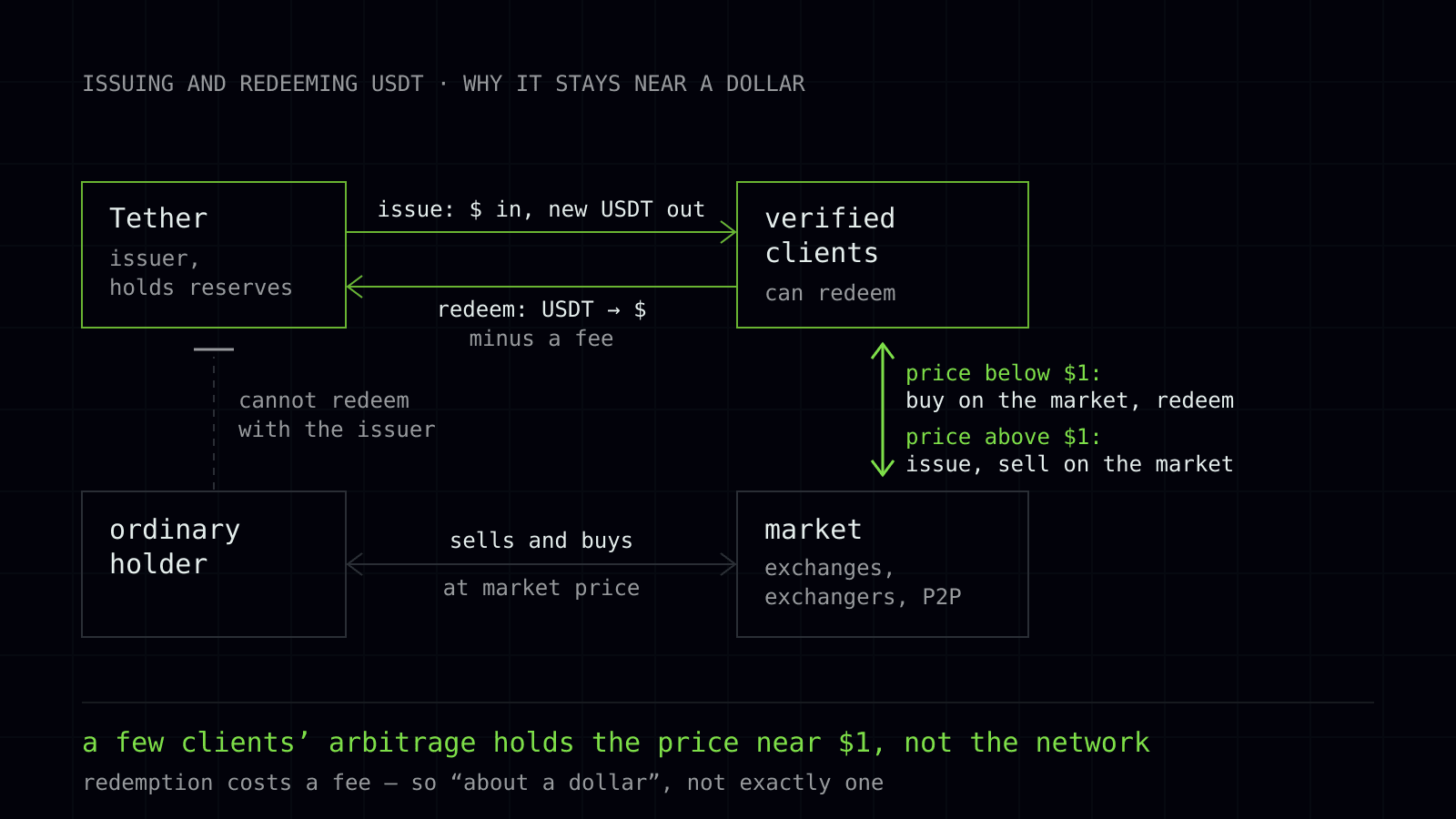
The price stays near the dollar thanks to arbitrage. If USDT trades below face value on an exchange, it pays for a verified customer to buy it up and redeem it with the issuer; if above, to issue new tokens and sell them. Both trades push the price towards one. So USDT’s stability is not a law of nature but the work of a few large participants.
Direct redemption is not available to everyone. Under Tether’s fee schedule as of 15.10.2026, the minimum is 100,000 dollars, the fee is the greater of two amounts — 1,000 dollars or 0.1% — and account verification costs 150 dollars. According to the company’s own document, as of 16 February 2026 there were 819 verified customers with this right in the whole world. An ordinary USDT holder can only sell the token to another person or to an exchange service at the market price.
Hence the “almost a dollar”: on a minimum redemption the fee takes 1%, so, by our calculation from the fee schedule, a verified customer receives 0.99–0.999 dollars per token from the issuer, not exactly one dollar. A detailed breakdown of the mechanism and of all the deviations is in the article on whether USDT can lose its peg to the dollar.
What backs USDT: what is in the reserves
The latest quarterly reserves report is as of 30 June 2026 and was signed on 31 July. Assets are 187.75 billion dollars, liabilities 183.64 billion, and the excess about 4.11 billion, that is, a little over 2% of liabilities. As of 15.10.2026 it is still the latest report on the company’s transparency page.
The composition of assets in the same report: US Treasury bills about 61%, reverse repurchase agreements about 14%, cash and bank deposits 0.021%. The rest, roughly a quarter, is precious metals (10.03%), secured loans (7.17%), bitcoin (3.09%) and other investments. In other words, the “dollar per token” is backed by a portfolio of assets, not by dollars sitting in accounts.
This report is not an audit of the company. It is prepared by Tether’s management, and an independent firm issues a conclusion under the ISAE 3000 standard — meant for engagements other than audits — and only as of a single date. In August 2026 the company announced that a full audit for 2025 had been completed, but as of 15.10.2026 it is not on its transparency page — only the quarterly conclusions are.
And two things from Tether’s user agreement (captured 19.09.2026): USDT is not legal tender, and there is no deposit insurance on it — neither American nor any equivalent. That is exactly what sets it apart from a dollar in a bank account.
Networks: TRC20, ERC20 and others
USDT is a token, not a separate blockchain: it lives inside other networks and has its own contract in each. On the issuer’s page, as of 14.10.2026 USDT is in circulation on 13 networks, but the distribution is uneven.
Network (standard) | Share of supply as of 14.10.2026 | We accept |
|---|---|---|
TRON (TRC20) | 50.62% | yes |
Ethereum (ERC20) | 46.94% | yes |
Solana | 1.51% | no |
TON | 0.30% | no |
Nine more networks | under 0.7% combined | no |
An address on TRON starts with the letter T, on Ethereum with 0x. The network is chosen by the recipient’s wallet or service: the network you send on and the network of the address must match. The fee for a USDT transfer is usually paid in the coin of its network — TRX on TRON, ETH on Ethereum — so without it in the wallet the transfer, as a rule, will not go through.
The cost of a transfer depends on the network and how busy it is; the wallet shows it before sending. In our measurement on 19.09.2026 a transfer in ERC20 cost less than in TRC20 — but that is one day’s state, not a rule. How to choose a wallet and where to get an address is covered in the article on a wallet for USDT.
A separate note on BNB Smart Chain and the BEP20 standard. On Tether’s page, the supply on this network is zero. The token called USDT there was not issued by Tether: the network’s explorer labels it as a wrapper (our check on 19.09.2026).
And on the Omni, EOS, Algorand, Kusama and Bitcoin Cash SLP networks, the issuer no longer issues USDT and is not obliged to redeem it. A comparison of networks for transfers is in the breakdown of TRC20, ERC20 and BEP20.
When USDT fell below the dollar: May 2022
The peg has broken before, and the best-known episode is May 2022. That was when the algorithmic stablecoin UST collapsed — there was no issuer behind it obliged to pay out a dollar — and trust in all stablecoins sagged at once.
On 12 May 2022, within two morning hours UTC, USDT dropped to 0.91 dollars on one exchange, to 0.94 on another, and only to 0.9975 on a venue linked to the issuer, where direct redemption is available. This is our measurement from the exchanges’ hourly data. The price returned to the ±0.5% corridor around the dollar in less than two days.
Money really was leaving at the time: from 5 to 28 May 2022 the amount of USDT in circulation shrank by about 10.7 billion dollars, or 12.8% (DefiLlama series). On 31.05.2022 the company itself stated that it had fulfilled redemption requests for 10 billion dollars within a single week. These are different quantities — gross redemptions and the change in circulation — so they cannot be added together.
USDT had fallen deeper before: on 15 October 2018 a trade on one of the exchanges went through at 0.85, and on that same exchange the price came back to the dollar only in mid-December.
Daily closes look calmer than individual trades: on CoinMarketCap’s composite index, not a single trading day in 2022, 2024, 2025 and 2026 (up to 19.09) closed outside the ±0.5% corridor — not even 12 May 2022. In 2023 there were two such days, both upward: on 11 and 12 March USDT closed at around 1.007–1.008 dollars, on the days when USDC was falling because of trouble at a bank. This describes the past; it is not a forecast.
What USDT is used for in Ukraine
First, savings: keeping money in a dollar equivalent without opening a foreign-currency account or keeping cash at home. USDT can be transferred on any day and at any hour and held in your own wallet. The price for this is the issuer risk and the lack of deposit insurance discussed above.
Second, payment for work. Freelancers and remote workers get paid by foreign clients in USDT: they issue an invoice with the network and the address, and then decide when to convert it into hryvnias. How to set this up and what to think through in advance is covered in the article on getting paid for freelance work in cryptocurrency.
Third, transfers abroad: to family, for tuition, to a supplier. A USDT transfer does not depend on banking days, but the recipient needs a wallet and a way to cash out locally. The full cost of such a route versus a bank SWIFT transfer is worked out in a separate comparison.
There is no specific ban on an individual buying or holding cryptocurrency in Ukraine. The Law “On Virtual Assets” № 2074-IX was signed in 2022 but has not come into force — what that means in practice. What is restricted is the payment method: under NBU Resolution № 18, paying a foreign exchange for cryptocurrency by card is allowed only from a foreign-currency account and within a monthly limit (checked 15.10.2026).
How to get USDT and turn it into hryvnias
Here we have a direct interest: we are an exchange service, and exchanging cash for USDT and back is our business. But there are four routes: an exchange’s P2P section, the exchange itself, an exchange service and a crypto ATM. They are worth comparing by the final price, not by the rate in a listing — how to work it out is covered in the article on how to buy USDT in Ukraine.
With us, buying works like this: you place an order on the page for buying USDT for hryvnias, the rate is locked for the time stated in the form, a manager confirms the place and time of the meeting, at the cash desk you hand over the cash, and the USDT goes to your address. USDT is exchanged for cash in six cities; which directions are open right now is shown in the USDT rate table.
The reverse route is selling USDT for cash hryvnias or dollars on the page for exchanging USDT for hryvnias. Where and when to send the coins will be shown on the order page and confirmed by the manager. A payout to a bank card is made by the manager by hand: the manager gives the rate, the timing and the terms for specific banks on request. Which works out better for 1,000 and 10,000 dollars is in the comparison of methods.
Risks: the network, freezing, fakes
The wrong network. A transfer on a network that the recipient’s address does not support can be lost for good. Before sending, check the network in your wallet against the network in the order or on the exchange. What to do if the coins have already gone to the wrong place is in the article on sending to the wrong network.
Freezing by the issuer. Tether’s user agreement (captured 19.09.2026) allows it to freeze tokens when the law requires it or when the company, at its own discretion, considers it prudent; the agreement does not name a court decision as a condition. According to our check, a frozen address can no longer send USDT but keeps receiving it.
The company has stated that more than 5 billion dollars’ worth of USDT has been frozen over its whole history (11.09.2026). How to check whether your address is on the contract’s blacklist is covered in the breakdown of address freezing. Separately: an exchange service may check the origin of the funds, and for a large amount documents may be requested under the law — what to keep for that is described here.
A fake token. Anyone can give their contract the name and ticker USDT, so a “USDT” that is worth nothing can show up in your wallet. Only the contract address identifies the real one — how to check it is described in the article on fake USDT.
Quick answers
How is USDT different from the dollar?
The dollar is issued by a state, and it is legal tender. USDT is an obligation of a private company: it is not legal tender, there is no insurance on it, and only a verified customer can redeem it with the issuer. The market price of USDT stays near the dollar but can deviate from it.
How much is one USDT in hryvnias?
On the global market, about a dollar. In hryvnias the price depends on the route: on an exchange it is closer to the market price, while for cash at an exchange service it is higher because it includes a spread. Our buy and sell rates by city, the market benchmark from CoinGecko and the percentage difference from it are shown on the rate page.
The rate depends on the amount: for a large amount it is better. The exact figure for your amount is calculated by the order form.
Are USDT and TRC20 the same thing?
No. USDT is the token itself; TRC20 is the token standard on the TRON network. “USDT TRC20” means USDT issued on TRON, and “USDT ERC20” means the same token in substance on Ethereum. It does not move directly between networks: a transfer stays within a single network.
Can USDT be mined?
No. New USDT is issued by Tether itself when a verified customer buys it for dollars, and destroyed on redemption. There are no block rewards in USDT. If you are offered “USDT mining”, it is not about issuing the token but about some other service that pays out in USDT, and its terms have to be checked separately.
How is USDT different from USDC?
Both are dollar stablecoins with reserves, but they have different issuers, different reporting and different access to redemption. By researchers’ count (NBER working paper, May 2025), USDT on the Ethereum network was redeemed by 6 arbitrageurs a month on average, USDC by 521. In detail: the difference between USDT and USDC; and what USDC is and how to buy or sell it for hryvnias is covered in a separate article.