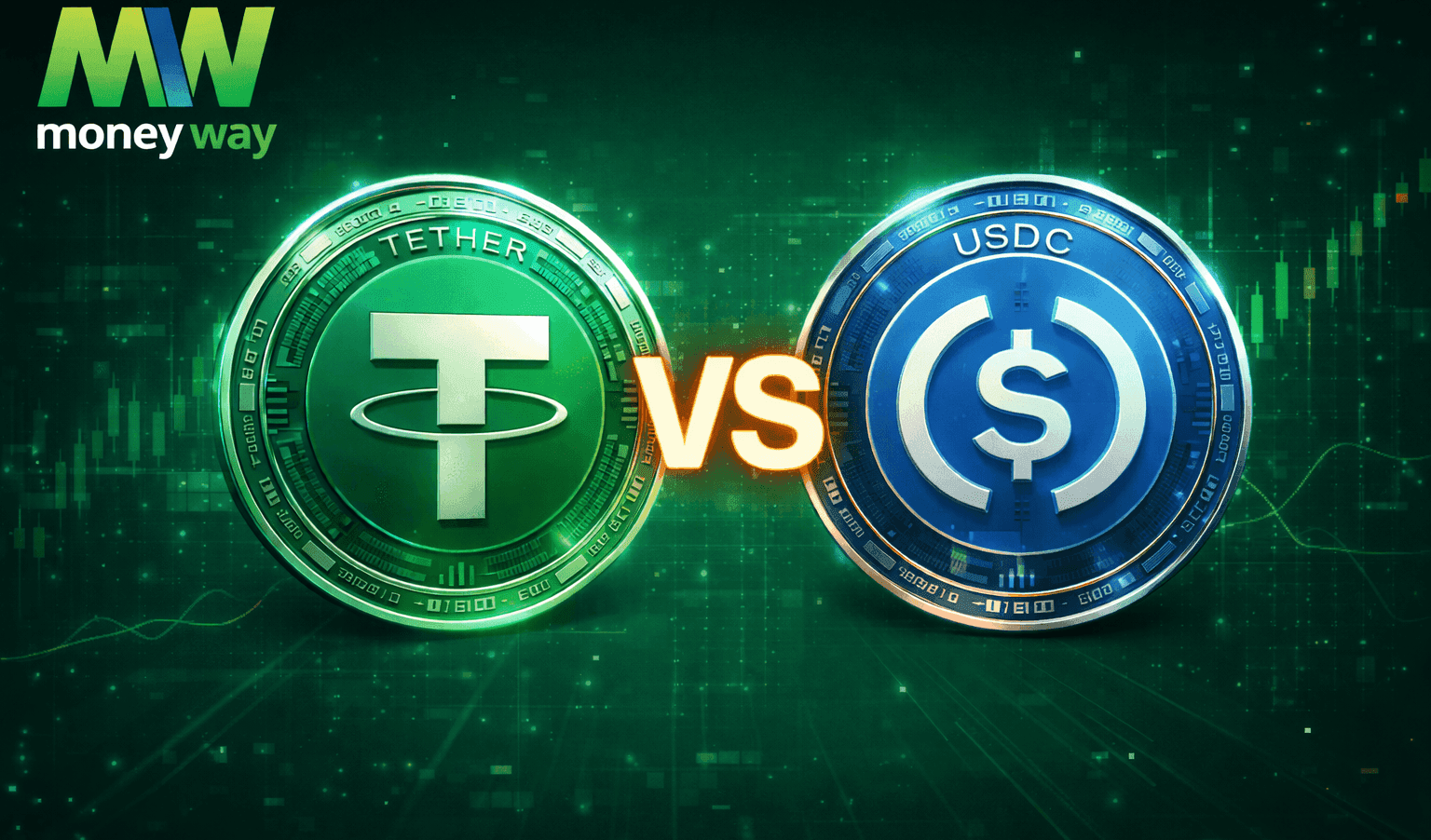
USDT and USDC are stablecoins pegged to the US dollar: both are worth about a dollar, both have already dipped below it, and both issuers can freeze the coins at an address. They differ in who issues them and who supervises them, what sits in the reserve and how often that is checked, and also in size and networks.
USDT is issued by Tether, a company based in El Salvador that reports on its reserve once a quarter; there is about 2.5 times more of it in circulation, and almost all of it lives on the TRON and Ethereum networks. USDC is issued by Circle, a publicly listed US company with a licence in the EU that discloses its reserve every week. USDC is on 38 networks, but it is no longer issued on TRON.
Our interest, up front: we are an exchange service and buy and sell both coins for cash hryvnias and dollars — USDT on the TRC20 and ERC20 networks, USDC only on ERC20. We do not offer a direct exchange of USDT for USDC. Each coin is covered in detail separately: what USDT is and what USDC is.
USDT and USDC: a comparison table
The main differences in one table. The figures change, so each one comes with the date it was checked.
USDT | USDC | |
|---|---|---|
Issuer | Tether International, S.A. de C.V. (El Salvador) | Circle (USA); in the EU, a French subsidiary |
In circulation as of 16.10.2026, per CoinGecko | about $184 billion | about $73 billion |
Reserve report | quarterly, as of a single date; the latest as of 30.06.2026 | composition weekly, Deloitte assurance monthly; the latest for August 2026 |
What is in the reserve | about three quarters in US Treasury bills and repo; the rest in metals, loans, bitcoin and other assets | about 85% in a US Treasury securities fund and repo; the rest in cash at banks and bonds |
Status in the EU | the issuer is not in the ESMA register (file dated 07.10.2026) | MiCA licence since July 2024 |
Redemption with the issuer | verified customers, from $100,000; on average 6 participants a month | Circle’s business customers; on average 521 participants a month |
Networks | 13; 97.6% of supply on TRON and Ethereum (14.10.2026) | 38 (15.10.2026); issuance on TRON stopped in February 2024 |
What we accept | TRC20 and ERC20 | ERC20 only |
Known drop below the dollar | May 2022: $0.91–0.94 on some exchanges, back in under two days | March 2023: $0.877 on composite indices, back in about four days |
Freezing | yes: under the law or at Tether’s discretion | yes: at Circle’s discretion on suspicion of illegal activity, or by order of an authority |
The number of redemption participants was counted by NBER researchers (May 2025) for the Ethereum network; all other holders can get out into dollars only by selling.
Who issues USDT and USDC and who supervises them
The issuer of USDT is Tether International, S.A. de C.V. In January 2025 Tether announced its move from the British Virgin Islands to El Salvador, citing the digital asset services licence it had obtained there. Since 27 January 2026 there has also been a separate Tether token for the US market, USAT, issued by the American bank Anchorage Digital. It is not USDT.
In the EU, things are more complicated for USDT: Tether is not in the register of e-money token issuers kept by the European regulator ESMA (file dated 7 October 2026). This does not stop you from holding and transferring USDT, but selling it for euros on a platform licensed in the EU, if you live there, may not work — more in the article on how to withdraw USDT into euros.
USDC is issued by Circle: its parent company is listed on the New York Stock Exchange and reports to the SEC. The token appeared in 2018 as a project of Circle and Coinbase through the Centre consortium, but in August 2023 the consortium was dissolved, and since then USDC has been run by Circle alone — so “Circle, backed by Coinbase” is out of date.
In the EU, USDC is issued by Circle’s French subsidiary under a licence obtained under the MiCA rules in July 2024. On 14 October 2026 the European Banking Authority (EBA) classified USDC as the first “significant” e-money token in the EU, and from 12 November 2026 the EBA will supervise its reserve and liquidity.
Reserves and reporting: what is checked and how often
Tether publishes a reserves report once a quarter. It is prepared by the company’s management, and an independent firm gives an opinion — not an audit — for a single date only. The latest report is as of 30 June 2026: assets of 187.75 billion dollars against liabilities of 183.64 billion, that is, a cushion of about 4.11 billion.
Circle discloses the composition of its reserve every week, and the audit firm Deloitte confirms every month that on the reporting dates the reserve is no smaller than the supply. According to the report for August 2026, on 31 August there were 73.32 billion USDC in circulation against a reserve of 73.40 billion dollars. It was signed on 29 September, so this report also comes out with a delay.
The composition differs too. For USDC, the reserve is cash at banks and short-term US government securities, mostly held through a money market fund. For USDT, about three quarters is invested in Treasury bills and repo, and the rest is precious metals, secured loans, bitcoin and other assets. And neither of these reports checks every day between the reporting dates.
Have USDT and USDC ever fallen below the dollar?
Yes, both, and for different reasons. USDT did on 12 May 2022, amid the collapse of the algorithmic stablecoin UST: for two morning hours UTC it traded at 0.91–0.94 dollars on some exchanges, and in less than two days it was back within ±0.5% of the dollar.
USDC did on 10–11 March 2023, when the American Silicon Valley Bank failed while holding 3.3 billion dollars of its reserve, about 8%. The price fell to 0.877 dollars on composite indices and returned to the dollar in about four days — after the US authorities promised the bank’s depositors they would be made whole. USDT held near the dollar in those days, and at times even above it.
According to NBER researchers, the fewer participants can redeem a coin with the issuer, the more its price deviates from the dollar on average — and here USDT falls behind USDC. But March 2023 showed that a large drop can happen to any stablecoin. How to read such figures is covered in the article on whether USDT can lose its peg to the dollar.
Networks: where each coin lives and on which network we accept it
Both coins are tokens inside other blockchains: each network has its own contract, and a coin does not move directly from one network to another. According to Tether, as of 14 October 2026 USDT circulates on 13 networks, but 97.6% of the supply is on TRON (the TRC20 standard) and Ethereum (ERC20).
USDC is issued on 38 networks, among them Ethereum, Solana, Base, Arbitrum and Polygon. On TRON, Circle stopped issuing it in February 2024: old tokens still circulate there, but TRON is not on Circle’s list of networks. And on some networks there is USDC.e alongside USDC — a version brought over by a bridge, with a different contract, which Circle does not issue.
We accept and pay out USDT on TRC20 and ERC20, and USDC only on ERC20, that is, on the Ethereum network. An Ethereum address is the same for USDT and USDC and starts with 0x, and addresses on Base, Arbitrum or Polygon look exactly the same. So in an order, check two things: the coin and the network.
An order expects exactly the coin and the network stated in it: a different coin sent to the same address will not complete it — if that happens, write to the manager straight away. What to do when coins have gone to the wrong network is covered in the article on a transfer to the wrong network. The transfer fee is paid in the network’s own coin: ETH on Ethereum for both stablecoins, TRX on TRON.
Liquidity in Ukraine: which is easier to buy and sell
Here we have a direct interest: we buy and sell both coins. According to CoinGecko, as of 16 October 2026 the market capitalisation of USDT was about 184 billion dollars and that of USDC about 73 billion, and USDT’s 24-hour trading volume was roughly three times larger. That is a snapshot of one day, but the order of magnitude of the difference is clear.
In Ukraine it is even more noticeable. On 15 October 2026, in the P2P section of Binance there were roughly 4–7 times fewer listings for USDC against the hryvnia than for USDT, depending on the side of the deal. Fewer listings mean a narrower choice of prices and amount limits, and finding a buyer for USDC may take longer.
At an exchange service the number of counterparties does not matter: the rate is set by the exchange service itself. On 16 October 2026 our hryvnia rate for USDC and USDT was the same, while the cash dollar rate differed by fractions of a percent; the rates are set separately, so this may change. The current rate by city, including on the USDC tab, is shown in the rate table. The rate depends on the amount: for a large amount it is better; the exact rate for your amount is calculated by the form.
Who can freeze USDT and USDC, and when
Both issuers can block an address, and the common belief that “USDC does not get frozen” is wrong: the USDC contract has functions for blocking an address and pausing transfers. What differs is the terms. Under Tether’s user agreement as amended on 26 February 2026, the company may freeze tokens when the law requires it or when it considers this appropriate at its own discretion.
The USDC terms (version of 15 October 2026) allow Circle to block addresses that, in its discretion, may be linked to illegal activity, and to freeze USDC on the order of a government authority.
The figures cannot be compared directly: on 11 September 2026 Tether said that more than 5 billion dollars had been frozen over its entire history, while Circle’s report as of 31 August 2026 shows 129.9 million USDC blocked on that date. What gets frozen is an address, not individual coins: the whole balance of that coin on it gets stuck.
How to check whether an address is on the blacklist is covered in the breakdown of address freezing. Separately: an exchange service may check the origin of the funds, and for a large amount documents may be requested under the law — what to keep is explained in the article on the origin of funds.
What to choose: cash in Ukraine, a transfer abroad or savings
Cash in Ukraine. If you already have coins, exchange the coin you hold: we accept both, and an extra USDT ↔ USDC conversion is one more spread. USDC on another network will first have to be moved to Ethereum, which comes with its own fee. You can sell on the pages for exchanging USDT for hryvnias and exchanging USDC for hryvnias; other routes are compared in the article on how to cash out USDT.
When buying with cash, think about where the coins will go next: USDT is easier to sell on P2P, while USDC has MiCA authorisation, which matters for EU platforms. You can buy USDT for hryvnias on the page for buying USDT; where buying USDC is open is shown in the rate table.
A transfer abroad. The coin is chosen by the recipient, not the sender: ask which coin and network their exchange or wallet accepts, and send exactly that. If the recipient is in the EU and will sell on a licensed platform, USDT may face restrictions there, while USDC has MiCA authorisation. For paying a supplier in China, we offer yuan payouts to Alipay for USDT and for USDC — how this works.
Savings. We do not give advice here; we only name what to compare. Both coins are obligations of private companies, not dollars in a bank account. The difference lies in the composition of the reserve, how often reports come out, supervision, and whether the coin will be easy to sell where you need the money.
Quick answers
Which is more reliable, USDT or USDC?
There is no clear-cut answer, and we do not rank them. USDC has more frequent reports, a simpler reserve composition and a licence in the EU; USDT has a larger supply and more buyers and sellers, including in Ukraine. Both have dipped below the dollar, and both issuers can freeze an address.
How do you swap USDC for USDT and back?
On an exchange, through the USDC/USDT pair or in the convert section: it is a separate trade with a fee or a spread, after which the coins still have to be withdrawn on the right network. We have no direct USDT ↔ USDC pair; through us it would take two orders via cash, with two spreads and a visit to the cash desk.
Which USDT is better, TRC20 or ERC20?
The coin is the same — USDT from Tether; only the network differs. Choose it according to the recipient: the sending network and the address’s network must match. We accept both. How to compare networks is covered in the article on TRC20, ERC20 and BEP20.
Is there USDC on the TRC20 network?
Not new USDC: Circle stopped issuing USDC on TRON in February 2024. Previously issued tokens still circulate there, but according to Circle’s report only their redemption is supported on that network. We accept USDC only on the Ethereum network. More about the token itself in the glossary.
How much is USDC in hryvnias?
On the global market, about a dollar, just like USDT. In hryvnias the price depends on the route and the amount; on 16 October 2026 our hryvnia rate for USDC was the same as for USDT.