It can — and it already has. On 15 October 2018 on one of the exchanges a USDT trade went through at 85 cents, and by the exchange candles the price came back above the dollar only in the middle of December: about two months. In the spring of 2017 five weeks in a row closed below the dollar, with a low of 89 cents. At the same time, in 2022, 2024, 2025 and 2026 not a single trading day closed outside the ±0.5% corridor.
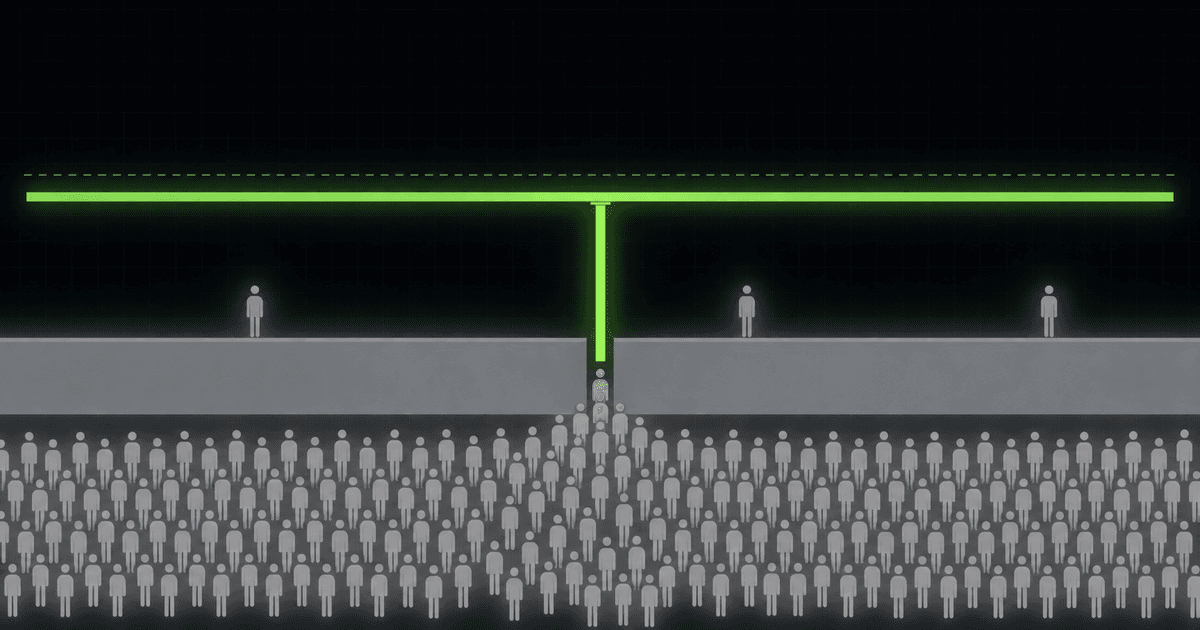
The peg is held not by the reserves in themselves but by the right to redeem the token with the issuer at face value. That right is personal: verified customers of the company have it, and on 16 February 2026 there were 819 of them in the whole world; issued as of 19.09.2026 — 183 billion tokens. An owner who bought USDT on an exchange does not get such a right.
Redemption has a price. The minimum amount is 100,000 dollars, the fee is the greater of two figures: 1,000 dollars or 0.1%. On the minimum volume that is exactly one percent, so the token comes out at 99 cents, and on a million — 99.9 cents. The issuer has not promised exactly a dollar to anyone, hence the eternal “almost a dollar”.
A quarterly attestation of reserves is not an audit of the company: the document itself says that it is not financial statements and that it concerns a single calendar date. In August 2026 the company announced that a full audit for 2025 had been completed, but it did not publish the report, and all the figures from it are known only from what the company says.
Who can exchange USDT for dollars with the issuer
USDT is a stablecoin: the rate rests on the company's promise, not on the mathematics of a network. Under the user agreement (captured 19.09.2026) only a verified customer has the right to issue and redeem tokens, and that right is called there a personal right of the customer. It does not pass along with the token.
In the same place: USDT is not legal tender, it is not backed by a state, and there is no deposit insurance on it — neither American nor equivalent. That is the answer to the comparison with a bank account. A separate line about backing: the reserves may include loan claims on affiliated parties.
The number of holders of that right is known exactly: by the issuer's document of 20.02.2026 — 819 verified customers as of 16.02.2026. An independent working paper (May 2025) that counted redemptions on the Ethereum network puts it more sharply: in USDT an average of six arbitrageurs a month redeem, against 521 in USDC. How the token is built — what Tether is.
The arithmetic of redemption: why the price “floor” is below the dollar
The issuer's fee schedule, captured 19.09.2026: the redemption minimum is 100,000 dollars, the fee is the greater of 1,000 dollars or 0.1%, the verification charge is 150 dollars. The agreement warns that the fees change at the company's discretion. The calculation below is ours, not the issuer's.
redemption volume | fee | per token |
|---|---|---|
100,000 USDT | $1,000 (1%) | $0.99 |
500,000 USDT | $1,000 (0.2%) | $0.998 |
1,000,000 USDT | $1,000 (0.1%) | $0.999 |
10,000,000 USDT | $10,000 (0.1%) | $0.999 |
The price “floor” that redemption creates lies at 0.99–0.999 dollars, not at 1.00. Swings in tenths of a percent are not a broken peg but the peg doing its usual work. There are three limits.
The profitability threshold. Arbitrage makes sense below 0.990 on the minimum volume and below 0.999 from a million upwards. Anything between 0.990 and 1.000 on small amounts the mechanism will not put right.
There is no deadline for carrying it out. Neither the agreement nor the document for the regulator has a deadline — checked by a search through the full text. How long a redemption takes in fact, there is no public data on that either.
Redemption can be stopped. The agreement allows the issuer to delay or suspend it at its own discretion: the instrument that brings the price back to face value can be switched off exactly when it is needed most. In the 2022 version the agreement expressly allowed settlement in securities from the reserves. Between June 2024 and January 2026 that clause was removed from the agreement.
What is in the reserves and what has been attested
The latest quarterly report is as of 30.06.2026, signed 31.07.2026. Cash and equivalents are 74.91% of assets: US Treasury bills 61.23%, reverse repo 13.65%. Cash and bank deposits are 0.021%. The remaining 25.09% is gold 10.03%, secured loans 7.17%, bitcoin 3.09%, other.
The excess of assets over liabilities is 4.11 billion dollars, 2.24% of liabilities; over half a year it fell from 6.34 billion, by 35%. A quarter of the backing would have to be sold if the need arose, and the buffer for revaluation is two percent and a bit.
The quarterly document is issued under a standard that is called exactly that: “assurance engagements other than audits or reviews of historical financial information”. The same thing is said in the document in five turns of phrase.
- Not the company's financial statements but a selection from its accounting records.
- IFRS principles have been applied, but there is too little data for IFRS statements.
- The conclusion is limited to one date; what came before and after was not looked at.
- There is no conclusion on the company's ability to continue as a going concern.
- The assets are valued for a normal market, not for an extraordinary one.
The last point matters more than all the others: the figure “more assets than liabilities” was counted for a calm market, and people will want to test it in a turbulent one. Two facts with no guesswork: the engagement was commissioned by the parent fund, not by the issuer; the auditor named on the company's site is one legal entity of the BDO network, and the signatory in the PDF is another.
On 24.03.2026 the company announced that it had hired a “Big Four” firm, and on 13.08.2026 that the audit for 2025 was complete with an unqualified opinion from KPMG. As of 19.09.2026 the report has not been published. The excess claimed is 6.814 billion, while the quarterly document as of 31.12.2025 gives 6.34 billion: the numbers do not add up.
When the peg really did break
October 2018 — the deepest and the longest fall. The trade at 0.85 went through on 15.10.2018 at 06:51:29 UTC with a volume of 39,965 USDT. The price held below 0.90 for 41 minutes (0.73% of the day's volume), and below 0.95 continuously for more than a day; the high over three days was 0.9991.
The volume-weighted average for the day was 0.9511, on a volume roughly fifteen times the usual. In November a second wave came with a low of 0.931, and the first close above the dollar on the composite index was 01.12.2018.
It lasted seven weeks because the direct redemption channel was not working. The issuer called the former model unmanageable and restarted redemptions on 27.11.2018 — straight away with a minimum of 100,000 dollars and a limit of one redemption a week. The minimum has held from then into its eighth year; the weekly limit is no longer in the fee schedule.
A state document from 2021 describes what was happening at the time with the issuer and the affiliated exchange, but it does not establish the reasons for the move in the exchange price: the coincidence of dates is our own comparison.
May 2022 — the episode that explains the mechanism best. The trigger was the collapse of an algorithmic stablecoin: trust sagged in all issuers. On 12.05.2022, in one and the same hour, USDT cost 0.91011, 0.941 and 0.99753. The most expensive was on the venue affiliated with the issuer and with direct access to redemption, cheaper on the retail ones. This is the figure “819” on a chart.
The scale on the venue where we counted trade by trade was modest: it traded below 0.95 for 22 minutes, 0.213% of volume, and the price came back into the corridor in less than two days. Supply from 5 to 28 May shrank by 10.66 billion (12.8%); gross redemptions were higher — the issuer was issuing on those same days. There is a separate estimate, and in another currency: the ECB named an outflow of more than 8 billion euros (bulletin, July 2022).
June 2022 — the counterexample without which this section would be dishonest. In nine days supply shrank by another 5.35 billion, and the price did not flinch: the index did not leave 0.9975–0.9994. Five and a half billion went unnoticed.
The longest breakaway was upward
For 48 days in a row, from 16.12.2018 to 01.02.2019, the composite index closed outside the ±0.5% corridor, in the range 1.0063–1.0315: the longest unbroken run of such closes in the whole history. “Depeg” and “loss of value” are different things: a deviation upward measures not the quality of the token but the quality of the dollar it is being set equal to on the venue.
On 11.03.2023, the day after the collapse of an American bank, USDC fell to 0.80526 on one of the venues — on others in the same hour the low was higher, 0.874 and about 0.877 by the indices. USDT that day rose to 1.05, and on 10.10.2025, the day the market collapsed, it did not go below the dollar: the high on three venues ranged from 1.02764 to 1.07264.
How the tokens differ in the way they are built — the difference between USDT and USDC. A collapse of the crypto market does not by itself break the USDT peg. It goes downward when the doubt is about the issuer itself, not about the market.
How to read the numbers about depegs
For one date there are three different true numbers. Take 04.02.2026.
measure | what it shows | 04.02.2026 |
|---|---|---|
tick low | one trade | $0.96985 |
volume-weighted average for the day | real trading | $0.99821 |
composite index low | average across venues | $0.9971 |
All three are correct and they measure different things. “USDT fell to 97 cents” is technically accurate and practically empty: over those two days 167 trades went through below 0.995, 0.65% of volume.
Hence a correction. “On different exchanges USDT always costs something different” is wrong. Our measurement across five venues on 19.09.2026 gave a spread of 2.7 basis points (0.027%), and an academic paper calls such differences negligible. Prices diverge only under stress.
And about outliers: a single trade on a thin order book lands in the series on a par with all the rest, which is why the history holds both 4 and 1,000 dollars per USDT. That is not a price.
The regime has changed
The composite index, 3,167 trading days from 27.11.2017 to 19.09.2026. The share of days outside the ±0.5% corridor:
period | days outside ±0.5% |
|---|---|
2017–2019 | 39.2% |
2020–2021 | 4.27% |
2022 | 0% |
2023 | 0.55% |
2024 | 0% |
2025 | 0% |
2026, to 19.09 | 0% |
USDT closed at exactly 1.0000 dollars on only 198 days out of 3,167, 6.3% of the time. On 19.09.2026 at 14:12 UTC the price was 0.999615 and the capitalisation 183.31 billion dollars.
Not “USDT has become reliable” — that we do not know. Up to 2020 deviations were an ordinary matter, from 2022 they have almost disappeared at the daily scale, the only exception being 2023. The risk has shifted from an everyday thing to a rare event.
Professional observers say the same. The Federal Reserve: arbitrage stops working when the market loses faith in the peg. The Bank for International Settlements, a 2023 review: no stablecoin has held parity the whole time.
And the researchers who counted the arbitrageurs warn: “trading below the dollar” and “the peg has broken” are not the same thing. They compare the secondary price with the price of a share in an exchange-traded fund — that is the answer for anyone who saw 0.998 and took fright.
Short answers
Can I exchange USDT for dollars with the company itself?
No, unless you are a verified customer of the issuer. You need the status, a minimum of 100,000 dollars for a redemption and the fee, and the company has the right to accept or reject the request at its own discretion. For everyone else only selling the token on the market is available.
Is USDT backed by dollars one to one?
Cash and bank deposits are 0.021% of assets as of 30.06.2026. The backing is a portfolio: three quarters in Treasury bills and repo, a quarter neither money nor equivalents. The cover with an excess of 2.24% is in assets, not in dollars in accounts.
Has Tether been through an audit?
On 13.08.2026 the company said a full audit for 2025 was complete and did not publish it — everything is known from what the company says. And what is published every quarter is not an audit, by the name of its own standard.
What will happen if the peg breaks?
We do not make forecasts. What is measurable is something else: the peg comes back from the top down, first where there is direct redemption. On 12.05.2022 the gap between such a venue and a retail one reached almost nine cents. The retail owner is last in the queue.
Almost all USDT lives on two networks: as of 18.09.2026 TRON holds 50.48% of the issuance and Ethereum 47.32%. We are an exchange service and we work with USDT on both — exchanging USDT on the TRON network.