
The cheapest is an exchange, if the rate is all you count. The dearest is an exchange service, if the rate is all you count. But the rate is one of four components of the price, and on amounts up to a few thousand dollars the other three decide the outcome.
The three routes in brief
Exchange. You deposit USDT, sell at the market price and withdraw hryvnia. The rate is the best of the three. In return: registration, identity verification (KYC), a withdrawal fee and timing that does not depend on you.
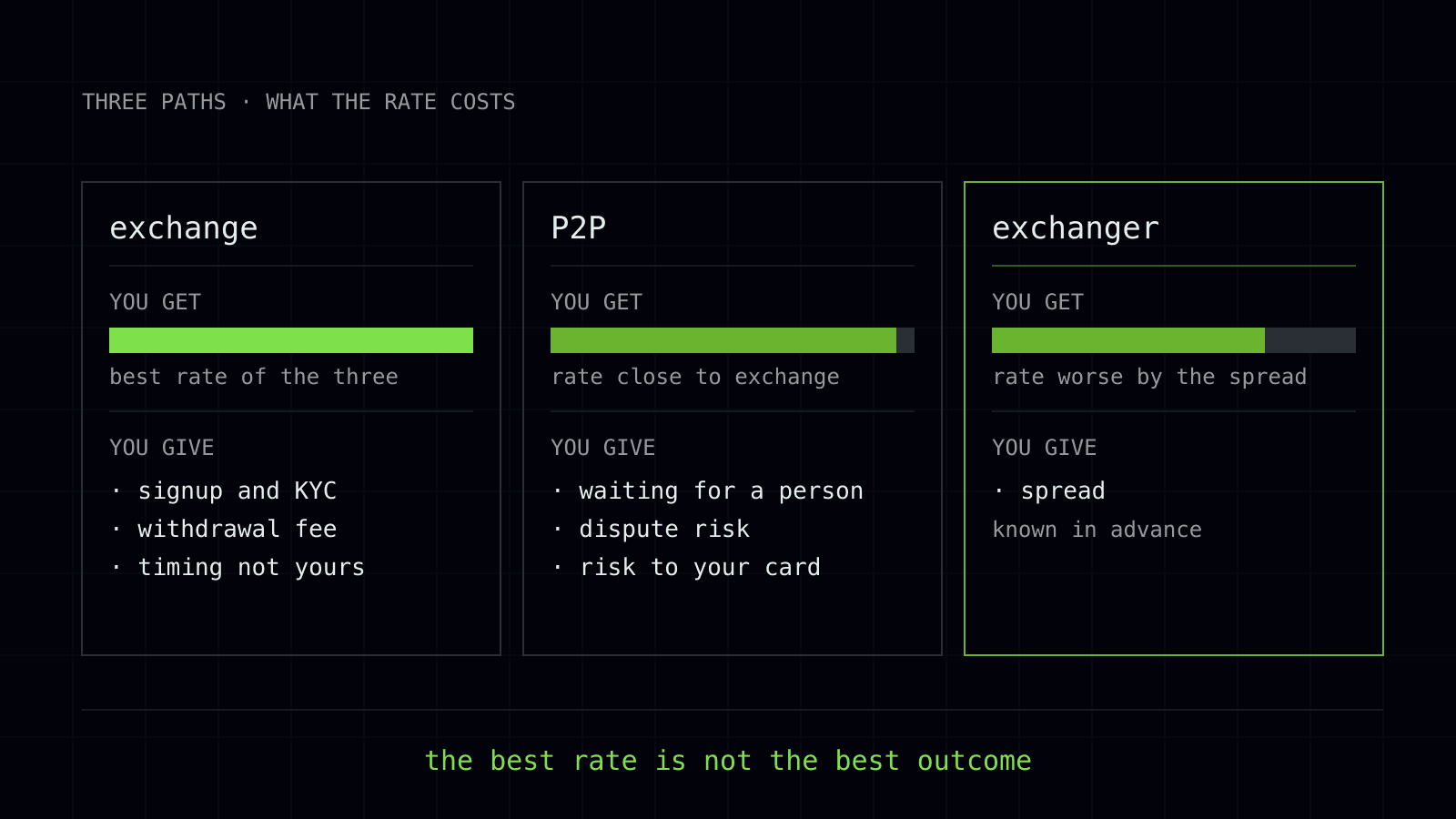
P2P. Settlement directly with a person through an escrow platform. The rate is close to the exchange rate. In return: time spent messaging, the risk of a dispute and, above all, a payment to your card from a private individual. More in the glossary: P2P exchange.
Exchange service. The service is itself a party to the deal: it quotes a rate, fixes it and settles with you. The rate is worse than the exchange rate by the spread. In return: a known price, a known timeframe and a single counterparty you can hold to account.
Costing it out on a thousand dollars
Take 1000 USDT and count the bottom line rather than the rate. Exact numbers depend on the day, so look at the cost items rather than at specific sums.
On an exchange, added to the rate are: the trading fee, the hryvnia withdrawal fee and the difference between the price in the order book and the price your volume actually fills at. Plus time, from an hour to a day if identity verification has not been completed yet.
In P2P there are almost no costs, but you add waiting for the other side and the chance that the deal will have to be cancelled and started again. And one item that is rarely counted: explaining to your bank where a transfer from a stranger came from.
At an exchange service there is one cost, the spread, and it is known up front. Everything else is included in the quoted number.
What actually decides it
The amount. On a hundred dollars the rate difference between the three routes is a few hryvnia, while the time difference is hours. On ten thousand the picture flips.
Urgency. If you need the money today, an exchange with verification still pending is not an option at all.
Source of funds. A bank reads a transfer from a company differently from a stream of transfers from private individuals. This is not about legality but about how many questions you will have to answer.
Willingness to figure things out. An exchange requires understanding the order book, networks and fees. Picking the wrong network on deposit costs more than the entire gain on the rate.
Who each one suits
Regular turnover, large amounts, comfort with holding funds on a platform: an exchange.
Small amounts, time to spare, readiness for messaging and disputes: P2P.
A one-off exchange, a clear timeframe, no wish to open accounts or explain yourself to a bank: an exchange service.
And an honest caveat: we are an exchange service, so we have an interest in the third option. That does not make the first two any worse, they are simply about something else.