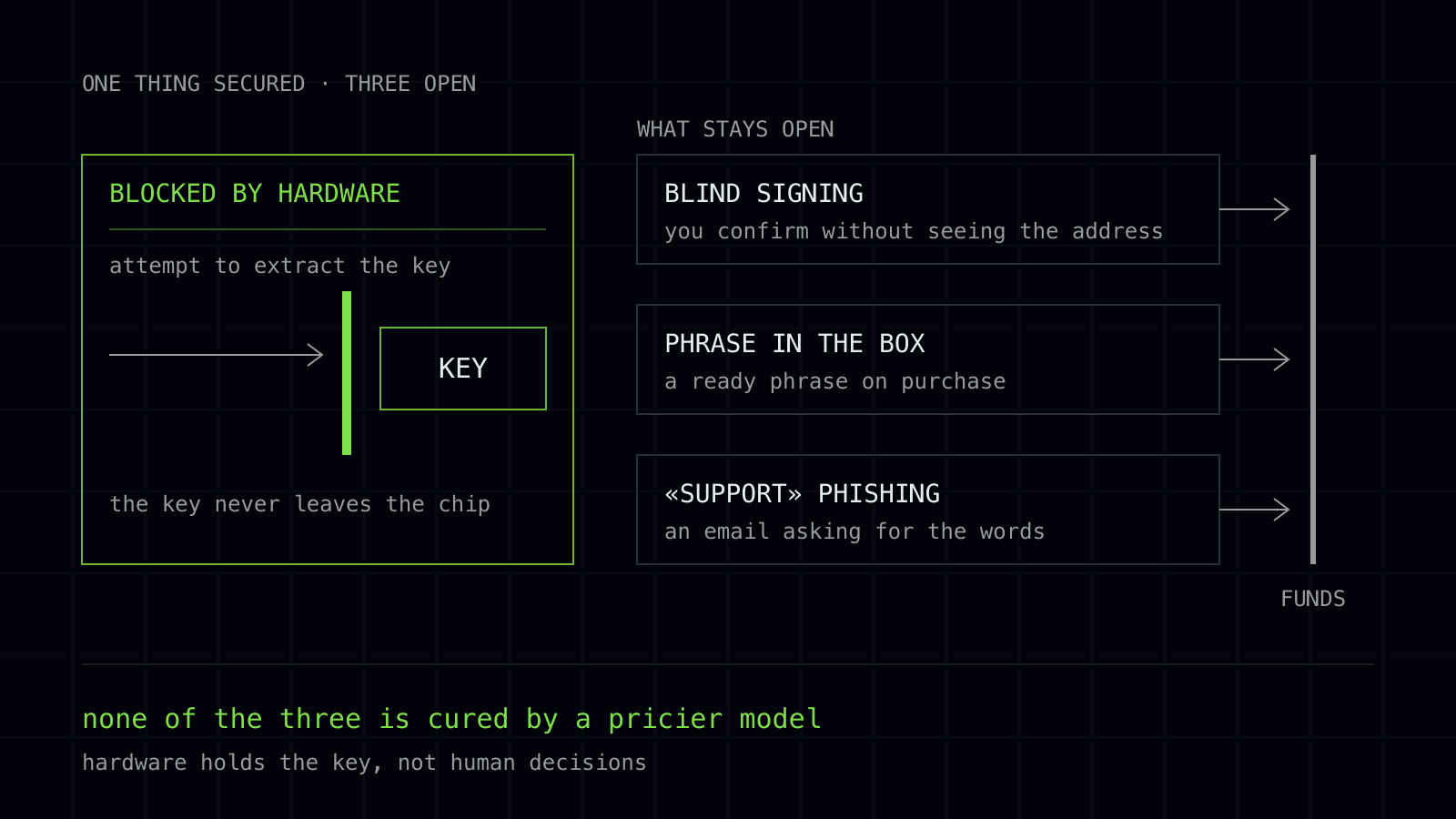
A hardware wallet guarantees exactly one thing: the private key never leaves the chip. That is a real and important guarantee, and it holds.
What it does not cover is three other things. The device does not guarantee that you understand what you are signing. It does not guarantee that nobody opened the box before you. And it does not guarantee that your name and home address are not sitting in a database that has already leaked. That is where the money goes, not through a broken chip.
The core point of this piece: none of the three ways to lose funds is cured by buying a more expensive model. We are an exchange service, not a wallet shop, so there will be no device review here, only a look at what the manufacturer leaves out of its advertising.
Blind signing: confirming what you cannot see
This is the main way to lose funds while holding hardware. In blind signing the device shows not the meaning of the transaction but raw data, a string in which a person can see neither the amount nor the recipient's address.
You press confirm, the key faithfully stays on the chip, the signature is faithfully applied. You simply signed something other than what you thought.
The classic scenario is interacting with a smart contract through a spoofed site. You believe you are confirming a small swap, while in fact you are granting permission to spend your entire token balance. The key leaked nowhere: the funds left under your own signature.
Tellingly, Ledger itself promotes clear signing as the answer to this hole. Which means the manufacturer acknowledges the problem.
And it acknowledges the key part: hardware alone does not solve it, because whether a transaction is readable depends on the application and the contract, not on the device. Source: the Ledger Academy sections on blind signing and clear signing.
Why a "sealed box" proves nothing
A genuine device is never shipped with a ready-made seed phrase or a preset PIN. That is the manufacturer's own wording.
If the box contains a card with words already written on it, or an instruction saying "use this PIN to activate", that is not factory convenience, it is somebody else's wallet you have been handed access to. You would be funding an address whose key belonged to another person from the start.
There is a second part here that gets discussed less. The chip authenticity check the device passes when connected to the official app confirms that the secure element is genuine.
It does not detect physical modifications to the hardware, and the vendor acknowledges this too. So "the check passed" does not mean "the device was never opened".
How to spot a counterfeit when buying
The first sign is any ready-made secret inside the box. A card with words, a sticker with a PIN, a sheet saying "your address for deposits". A genuine device arrives empty, and the first screen you see offers to create a wallet or restore your own.
The second sign is pressure on the order of steps. Counterfeit instructions ask you to fund the address first and sort out the settings later, or to run activation through a third-party site whose address you have to type in by hand. The official app is downloaded from the official domain, and there are no intermediate portals anywhere on that path.
The third is seals and shrink wrap, which are exactly what you should not rely on. A sticker is cheap to reproduce and shrink film is sold by the roll. That is precisely why the manufacturer's own materials move the check from the packaging to the device: what matters is not an intact box but the device asking you to create the secret in front of you.
The fourth is small inconsistencies. A different typeface on the printed materials, a link to a domain that resembles the official one, accessories that do not appear on the manufacturer's site. No single detail proves anything on its own, but together they are reason enough not to rush the first deposit.
Why a reseller is more dangerous than the cheapest device
Because the risks are of different kinds. A cheap model cuts corners on the screen, the range of supported networks and general convenience, but you generate the secret on it yourself, on an empty device, and nobody else sees those words.
A device from a reseller can be flawless hardware with somebody else's secret inside. The money goes not because something broke, but because you funded an address whose key another person already holds. The mistake surfaces at the moment when there is nothing left to recover.
The difference in consequences is what makes the comparison uneven. Saving on the model costs you some convenience. Saving on where you buy can cost you the entire balance, and it will surface not immediately but after the first large deposit.
The practical conclusion is simple. Buy the device from the manufacturer or an official partner, not secondhand, not from a classified ad, and not through a link in an ad.
Generate the seed phrase yourself, on a new device, and write it down the way described in our piece on storing a seed phrase. Any phrase that reached you ready-made is treated as somebody else's.
Phishing dressed as support: now on paper too
This method feeds on leaked customer databases and needs no technical vulnerability at all. The scheme is old: an email or message from "support", an urgent reason, a link to a cloned site, a field for entering twelve or twenty-four words.
Neither Ledger nor Trezor ever asks for a seed phrase, under any circumstances. That is a rule with no exceptions, and it does not bend to how convincing the message looks.
What is new here is the channel. In 2025 owners were sent printed letters on official letterhead, carrying a QR code that led to a copy of the site asking them to enter the words.
A paper letter bypasses every caution habit built up around email: it is not in the spam folder, it has no suspicious sender domain, and it physically sits in the mailbox at your address. Which is exactly why it works.
One sign is common to every variant: urgency. "Your device has been compromised", "urgent migration required", "update your backup by tomorrow". The rush exists so that you do not have time to recall the rule. Sources: BleepingComputer and Ledger's own phishing campaign tracker.
Ledger Recover: the row was not about a breach
In May 2023 the company announced a paid subscription for cloud backup of the seed phrase. What caused the scandal was not the service itself but the explanation from support: it had always been technically possible to write firmware that extracts the key from the device. That contradicted years of promising the key never leaves the device.
The launch was postponed on 23 May 2023, and the service did eventually ship on 24 October 2023, as an option, with encrypted key fragments held by three companies. Sources: CoinDesk (18 and 19 May 2023) and CryptoSlate (24 October 2023).
The lesson from this episode is not "Ledger got hacked". Ledger did not get hacked. The lesson is that the trust model turned out to be different from what the buyer assumed.
People thought they were buying a device physically incapable of surrendering the key. What they were actually buying was a device that does not surrender the key for as long as the manufacturer ships firmware that does not do so.
The gap between "impossible" and "not currently done" is what deserves your attention when choosing a cold wallet.
A side risk: your home address in a database that has leaked twice
Buying hardware means handing personal data to a shop. In 2020 Ledger's marketing database was compromised: roughly 1.1 million email addresses and 272,000 records with names, phone numbers and home addresses. The data was published openly.
No funds and no devices were affected, but a wave of phishing, extortion and ransom letters on paper followed.
In January 2026 a leak occurred at payment partner Global-e: names, addresses, emails, phone numbers, order details. The number of people affected was not disclosed. Sources: Ledger statements, HIBP, BleepingComputer, CoinDesk (5 January 2026).
This is not about the quality of the device. It is about a side risk of the purchase that the manufacturer leaves out of the spec sheet: your home address, together with the fact that you own cryptocurrency, ends up in a database that has already leaked twice. Hence the paper letters of 2025, which do not arrive at random addresses.
What follows from all this
The hardware closes one problem and closes it well: the key never leaves the chip. Everything else is on you.
Blind signing calls for the habit of reading the screen and never confirming what you do not understand. A counterfeit box calls for buying from the manufacturer and generating the phrase yourself. Phishing calls for the rule of never entering the phrase anywhere except the recovery screen of your own wallet.
And once more, the main point: not one of these three holes is closed by a pricier model. They are closed by what you do with your own hands.