Exchange time is made up of four legs, and the blockchain is only one of them. The network part for USDT on TRON takes seconds: the transfer goes through in about three seconds, and becomes final after 57 — that is a direct measurement from a network node on 19 September 2026. All the rest of the time is not the blockchain.
The rest is placing the order, agreeing it with an operator in the messenger and the payout back. The service's payout is manual on all 66 directions, and under its own rules the whole exchange after the payment arrives takes 5 to 20 minutes and depends on how busy the operators are. Both caveats are required — without them this stops being true: the interval covers all the manual work, not the payout alone.
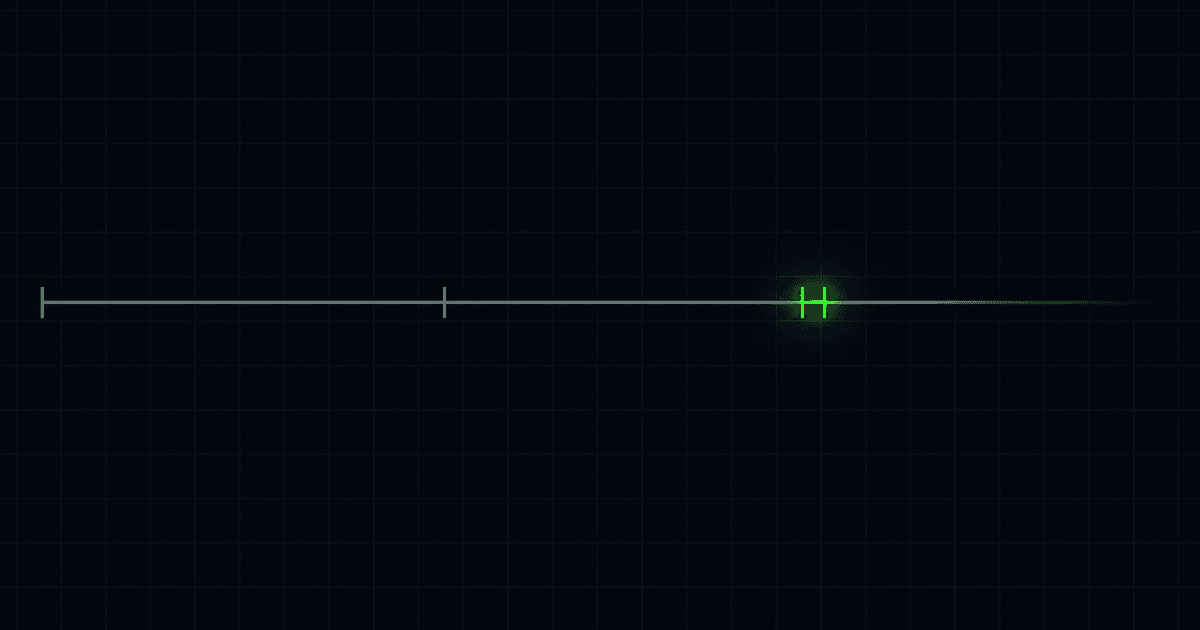
Nobody will name an exact time, and it is not out of caution. On that same day, with the bitcoin network empty, 27 minutes 46 seconds passed between two neighbouring blocks against an average of 9.6 minutes. Finding a block is a random process, and any figure in such a system describes the average, not your transfer.
The four legs of the journey
The legs are these: placing the order with the rate locked; agreeing it with an operator in the messenger; your transfer in the network up to finality; the payout back. The first and the third are measured in numbers, the second and the fourth depend on a person. How the deal itself is built — who transfers to whom first and where the rate comes from — is covered separately, in the article on how a crypto exchange service works.
Whose move it is now, the order page shows by itself. There are ten states, and they fall into three groups: your move (the heading “Send” with the amount and the currency, “Awaiting payment”), the service's move (“Waiting for confirmation of the transfer”, “Preparing the payout”) and the final ones — exchange completed, funds returned, order cancelled. The failure states stand apart: order frozen, payment did not go through, payout did not go through.
You do not need to refresh the page by hand. It checks the order status itself: every 10 seconds while the move is with the service, and every 30 seconds while the move is with you. In the final states the checks stop. An order can be cancelled only while it has not been paid.
Leg one: how long the rate holds
The rate is locked for a period set by the direction itself. Measurement of 19.09.2026: on 57 directions out of 66 this is 300 seconds, that is five minutes, and on nine it is 30 seconds. Thirty seconds is set on the USDC ERC20 to cash hryvnia directions and on the directions with a payout to a card.
The difference is a practical one. Five minutes is enough to paste the wallet address, reread the amount and tick the box. Thirty seconds is physically not enough for that. Why nine directions have exactly this period is unknown: it looks like a configuration mistake, but we have no confirmation of that, and we are not going to pass a guess off as an explanation.
Next, two timers get confused, and it is worth telling them apart. In the exchange form the timer counts down to a recalculation of the rate, and when it runs out the form is not locked — the rate is simply recalculated. On the page of an order that has already been created the timer is a different one: it counts down to the moment an unpaid order is cancelled. The first is about the price, the second about the life of the order.
Leg two: agreeing it in the messenger
There is not one manual step on the journey but at least two. After an order is created a manager contacts the person to agree the exchange — this is written into the texts of the directions themselves, not invented by the interface. For cash the same manager sets the time and place of the meeting: addresses are not published in advance, and the service states this as a decision, not as an oversight.
How long this step takes has been measured by nobody. Not by us, not by an outside observer. Until it is measured, no leg of the journey can be called the longest: the honest answer here is “we do not know”, not an estimate by eye.
Hence the practical consequence: the move passes to a person precisely in the messenger. The order of steps in a cash exchange is covered separately — how a cash exchange goes; there are deliberately no timings there, and this article does not add them, it explains where their absence comes from.
Leg three: in the network it is seconds, on Ethereum minutes
This is where the usual idea of where the time goes breaks down. All the numbers below were measured on 19.09.2026 in the window 13:57–14:19 UTC by direct requests to network nodes.
Network | Block | To finality |
|---|---|---|
TRON | 3.0 s | 57 s — 19 blocks |
Ethereum | 12.06 s | about 15 minutes |
BNB Smart Chain | 0.45 s | under a second by measurement |
Without three caveats the table lies. On TRON confirmations are counted not in blocks but in super representatives: for a block to become final, 19 out of 27 have to confirm it. The measurement of the lag gave exactly 19 blocks — 57 seconds, and twice, twenty minutes apart, the result matched to the second.
About Ethereum the figure “12.8 minutes” gets passed around. That is a minimum, not a typical value: finalisation happens only at an epoch boundary, so for an arbitrary block the delay drifts. Both of our measurements landed at 15.8 and 16.6 minutes — hence “about 15 minutes” in the table.
For BNB Smart Chain we could not get an exact finality time from the primary source: the documentation describes the mechanism, but there is no number. “Under a second” is our measurement of 19.09.2026, not a value from the specification.
And on a line of its own, the thing people write to the operator about most often: “confirmed” in the explorer and “final” are not the same thing. A TRC20 transfer gets its success mark in about three seconds, and becomes final in a minute. The difference between these two states is covered separately — confirmation of a transaction in the blockchain.
Why an exact time cannot be promised
The best example comes from someone else's network. On 19.09.2026 the average bitcoin block was 9.6 minutes, the mempool empty, the fee on the floor. And on that same day 27 minutes 46 seconds passed between blocks 967712 and 967713. One confirmation on an unloaded network took almost half an hour. The block numbers can be checked, and the fee has nothing to do with it: finding a block is a random process.
Bitcoin here is an example of the spread, not an exchange direction: the service has no such direction today.
The second layer, which is usually what decides the actual wait: how many confirmations to wait for is decided by the receiving side, not by the network. Thresholds differ from service to service, and most often it is the receiver's threshold that decides the crediting time. In our own case a threshold is named only for bitcoin — and bitcoin is not among the directions.
Leg four: the payout is done by hand
This leg is ours, and it is manual. Automatic payout is switched off on all 66 directions — checked on 19.09.2026: the system has the capability, but it is not enabled on a single direction. So every payout is started by a person. A transfer in the network will go through at any hour, while the manual leg exists only when a person is there: the operator's reply is tied to working hours.
The service's rules say the same thing in plain text: the exchange is carried out by an operator manually, and it takes 5 to 20 minutes after the payment on the order arrives, depending on how busy the operators are. Both caveats are part of the rule, not a softening of it: without them you get a promise of a time that nobody gave.
Our own interest out loud: we are an exchange service, the payout back is made by a person on our side, and that is our time, not the network's. On TRON it is a minute to finality against five to twenty minutes of manual work; on BNB Smart Chain the network part is shorter still. On Ethereum it is comparable with the manual part — about 15 minutes of network against the same five to twenty. Which leg is the longest, we do not know: nobody has measured the second one.
And the thing that matters more than the figure itself: “5–20 minutes” is a statement by the service, not a measurement. We have no statistics on completed orders, and the reviews section on the site is empty: on 19.09.2026 there was not a single review in it. There is nothing to confirm the time with from outside, and we are not doing so.
What really shortens the wait and what does not
Everything listed below affects the manual part of the journey — the part a person runs, not the network.
- The amount has to match down to the last digit. The network fee is paid by the sender, and a kopiyka that did not arrive turns the automatic matching of the payment against the order into a manual one.
- The network is chosen and paid for by the sender. A transfer that has gone into the wrong network is not sped up by anything: it will first have to be untangled, and that is no longer a leg of the journey but a separate story.
- A comment is not always needed. When paying in cryptocurrency an external payment service raises a one-time address tied to the order, and the payment is recognised by the address. When the payment goes to a permanent account, the comment is the only link between the payment and the order.
- The order page does not need refreshing. It checks the order status itself, and the transaction hash in the explorer will tell you only about the network leg — one of the four.
What is not on this list is advice to raise the fee. On TRON the price of a transfer is made up of the energy spent, not of a place in a queue, and it does not affect the speed of inclusion in a block that way.
If the next step is the exchange itself, we have a direction for USDT on the TRON network. We are an exchange service: the payout back is confirmed by an operator by hand, and under the service's rules the exchange takes 5 to 20 minutes after the payment on the order has arrived, depending on how busy the operators are.
Short answers
Why is the exchange taking so long if the explorer already says “confirmed”?
Because the network leg is not the whole journey. For USDT on TRON finality comes in 57 seconds — measurement of 19.09.2026. After that the order is run by a person: first the agreeing in the messenger, then the manual payout. “Confirmed” in the explorer means your leg is over, not the whole journey.
Why is the money from the exchange service not arriving even though the transfer has gone out?
Look at the order status, not at the explorer: the page shows whose move it is by itself and updates without you. The move is with the service — the manual part is under way. The move is with you — most likely a reply in the messenger is being waited for.
How long is the wait after the payment has arrived?
The service's rule is 5 to 20 minutes after the payment on the order arrives and depending on how busy the operators are. That is the time for the whole exchange after the payment, not for the payout alone. And it is a statement, not a measurement: we have no statistics of our own on completed orders, and there are zero reviews on the site. We cannot and will not name an exact time.
Can a transfer be sped up by raising the fee?
On TRON, no: there the price of a transfer is set by the energy spent, not by a place in a queue. And the network fee has no effect at all on the manual part of the journey — while on TRON it is the manual part that decides the wait, not the network.