
A crypto ATM turns cash into cryptocurrency in a few minutes with no bank account involved. That convenience has a price, and it comes in two parts: the visible operator fee and the hidden spread built into the rate.
Internationally that markup runs an order of magnitude above exchange pricing. Which is why the "crypto ATM rate" is almost always worse than the one you see on an exchange screen the same day.
Our own interest, stated up front: we are an exchange service, so we have a stake in any comparison with a crypto ATM. What follows is mechanics and sources, not a sales pitch.
How a crypto ATM transaction works
The machine looks like a bank ATM but runs in the opposite direction. You feed in banknotes, enter your wallet address by scanning a QR code or typing it in, and the operator sends cryptocurrency to that address.
The money never passes through your bank account: fiat in cash goes in, an on-chain transaction comes out.
Some machines also work the other way: you send coins to the operator's address and the machine dispenses cash once the network confirms. These two-way units are less common.
Identification depends on the operator and the amount. Some ask only for a phone number, others want a document, meaning a full KYC check. There is no single rule here, and that is a direct result of the regulatory gap.
What you need at the machine
A wallet that already exists. You need the address before you walk up to the machine: creating a wallet in a hurry while standing in a shopping mall and writing down the seed phrase on the spot is the worst possible start.
Showing the machine a QR code of your address from your phone screen beats typing the string by hand. Manual entry of a long address costs time and risks an error the network will not undo.
Check which network the machine uses for the coin you picked. A stablecoin exists on several networks, and an address valid on one is not valid on another. That is the mistake after which there is nobody to reclaim the funds from.
And one small thing that rarely gets mentioned: the receipt. The machine prints a slip with a transaction number, and that is your only proof if the transaction never lands. Photograph it immediately, thermal paper fades within months.
Why people use them at all
The main reason is cash. A crypto ATM covers the case where someone has paper money and either cannot or would rather not put it into an account.
The second reason is speed: the whole operation takes minutes, with no orders, no confirmations, no waiting for a credit to clear.
The third is the absence of a banking intermediary altogether. No payment reference, no questions from the bank's compliance desk at the funding stage. For a small one-off amount while you are out, that really is convenient, and the markup is exactly what that convenience costs.
What makes up the price
The price of a crypto ATM is the visible fee plus the spread in the rate. The operator shows the fee on screen: a nominal "5%".
The spread is the gap between the market rate and the one the machine calculates with, and it is never broken out as a separate line. We covered what a spread is separately. Together the two parts make up the real cost of the transaction.
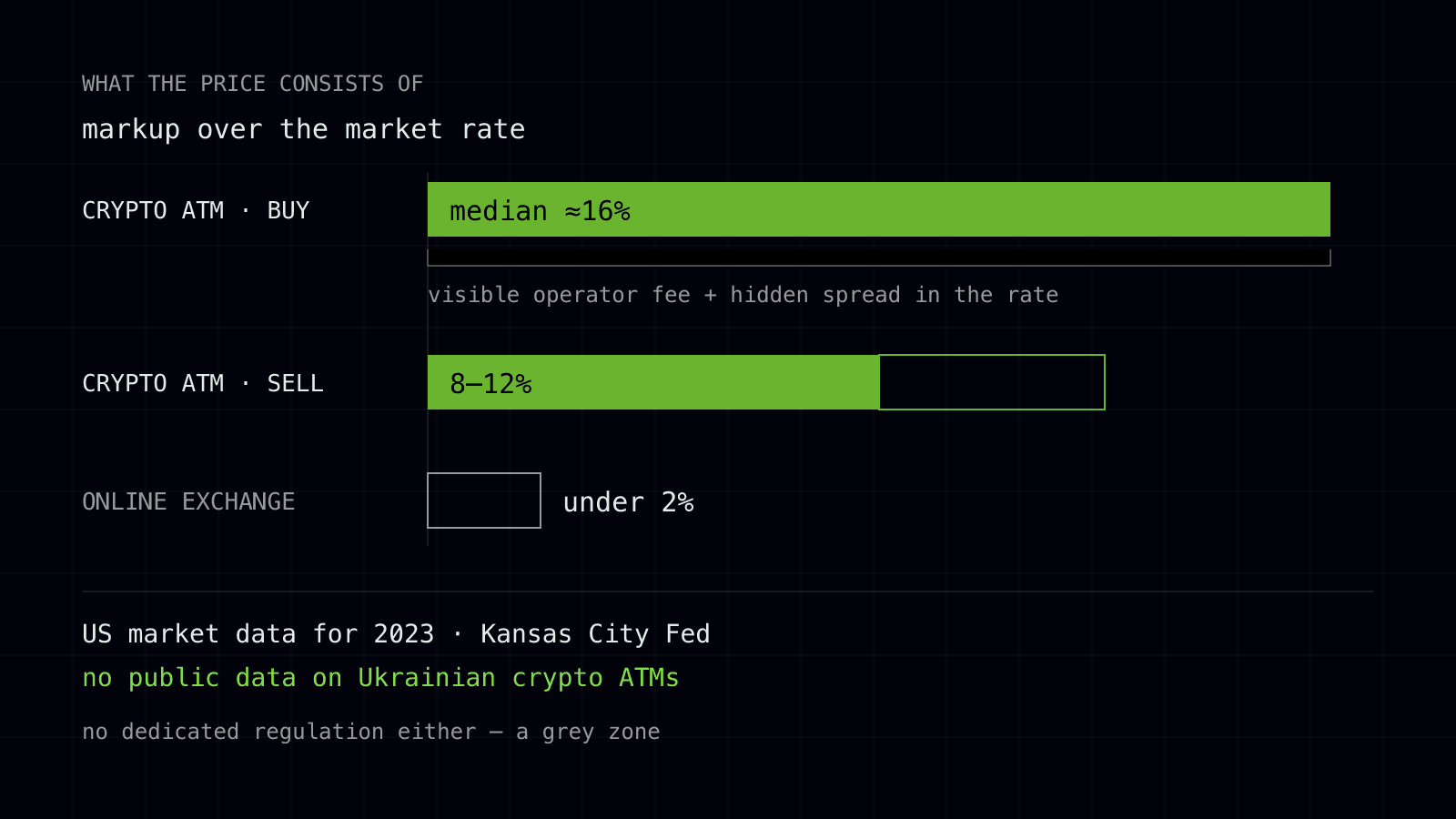
The size of the markup has been measured internationally. A 2023 study by the Federal Reserve Bank of Kansas City puts the median purchase fee at about 16% and the sale fee at 8–12%, against less than 2% on online exchanges. One caveat has to be stated plainly: those figures are US market data for 2023.
There is no public data at all on the fees charged by Ukrainian crypto ATMs: nobody has collected or published any. Applying 16% to a machine in Kyiv is not allowed, that would be passing off American statistics as Ukrainian. International practice indicates the order of magnitude; it does not give a specific number for Ukraine.
One practical conclusion follows: before you feed in the banknotes, compare the amount of coin the machine promises to deliver against the market rate on any major exchange at that moment. The difference is the full cost of the transaction, hidden part included.
What is the legal status of crypto ATMs in Ukraine
Ukraine has no dedicated regulation for crypto ATMs. The virtual assets law is not in force, and the updated bill has only passed a first reading. Meanwhile crypto ATMs are neither banned nor licensed: a grey zone until the law takes effect.
In practice that means the operator itself sets the identification requirements, the fee disclosure and the complaints procedure. There is no supervisory body to complain to about a rate. And there is no obligation to show the spread.
Hence the second practical point: in a dispute you are dealing with the operator directly. Banknote accepted, coin never arrived, and the matter is settled by its support team, on its timeline and by its rules.
The exact number of machines in Ukraine is unknown: aggregators differ by almost a factor of two, so we will not quote a figure. The accurate wording is a few dozen, mostly in Kyiv and the larger cities. The network is thin, and in many regional capitals there is simply no machine nearby.
When a crypto ATM makes sense and when it does not
It makes sense in a narrow case: a small amount in cash, needed here and now, with no bank account. A few thousand hryvnia, a one-off transaction, where time is worth more than the difference in rate. In that case the markup is the price of availability, and you are paying it knowingly.
It does not make sense on large amounts or regular transactions. The markup percentage does not shrink as the amount grows, while the absolute loss grows linearly.
On regular exchanges a few percent over a year adds up to something comparable to a month of your own turnover. That is arithmetic worth doing once, before the machine becomes a habit.
Separately: a crypto ATM does not solve the source of funds question. Cash leaves no paper trail, and that cuts both ways, since proving the origin of coins bought for cash at a machine will later be harder than for a documented transaction.