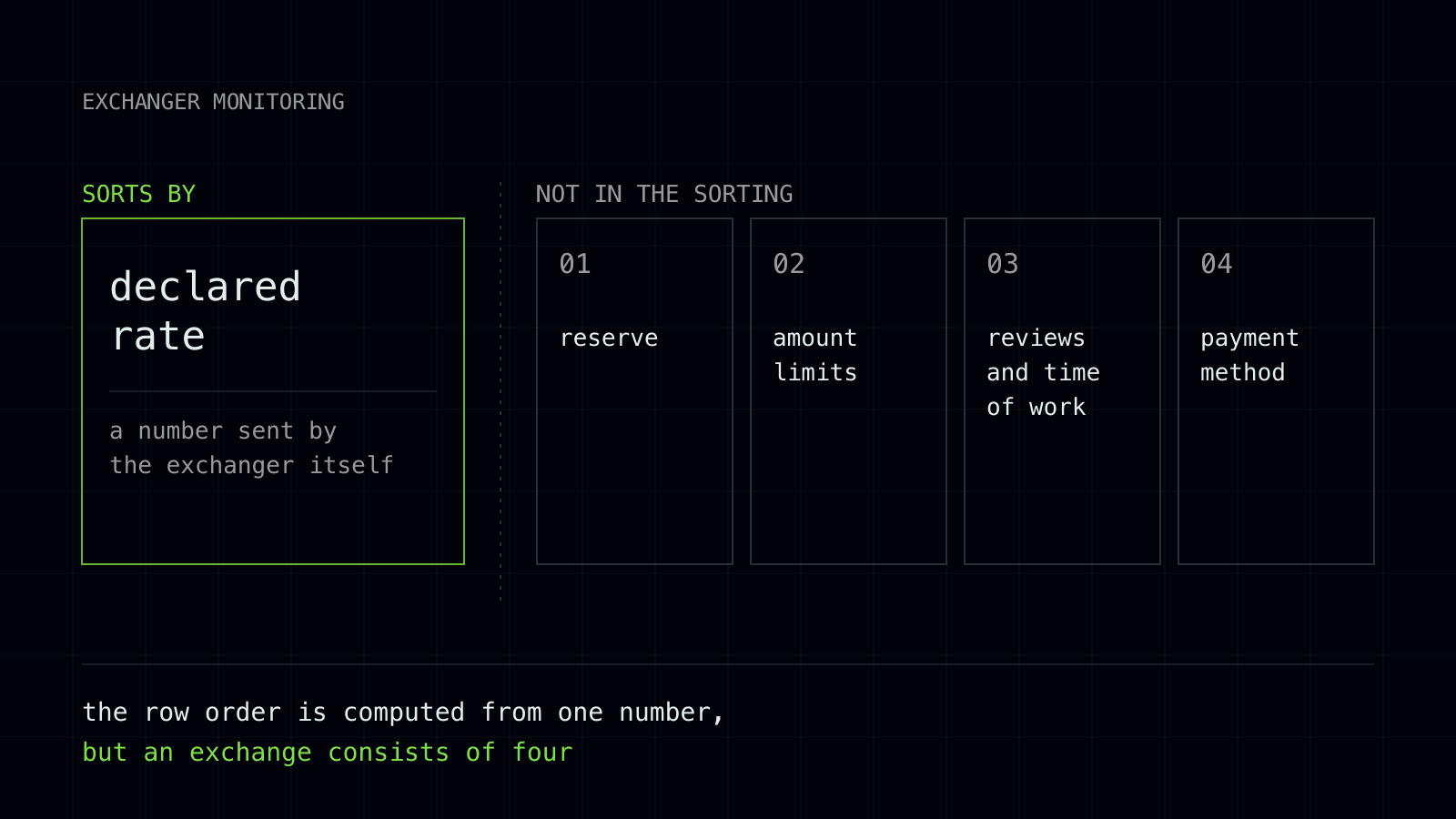
The top row on a monitor is the exchanger with the best advertised rate at this minute. Not the fastest, not the most reliable, and not the one with enough reserve for your amount. The ranking is calculated from one number, while an exchange is made of four.
How a monitor gets its data
Exchangers hand it a file with their own rates and reserves, usually every few minutes. The monitor does not verify any of it: it sends no test payment and never reconciles a stated reserve against a real balance. It shows what it was told.
The consequence is simple: the rate in a row is a promise, not a fact. You can only check it on the exchanger's own site, where the terms of the specific direction get attached to it.
Four columns instead of one
Reserve. How much the service can pay out right now in this direction. An order larger than the reserve will not settle instantly, even with the rate on display. Read more in the glossary: exchanger reserve.
Amount limits. The best rate often applies inside a narrow band, say from 500 to 2,000 dollars. Outside it the rate is different, and the monitor row does not show that.
Reviews and time in business. Not the star rating, but the actual texts from the past month. One write-up of a disputed transaction tells you more than a hundred "fast, thanks" notes.
Payout method. Card, cash, bank transfer: each has its own timing and its own limits. The direction "USDT to card" and "USDT to cash" are two different exchanges at two different prices.
Why the leader has the better rate
Some reasons are honest, some less so. Honest: a tight spread funded by volume, where the service earns on turnover rather than on the margin. Also honest: a promotion on one direction to pull in orders.
There are two dishonest ones. First, the rate only applies to an amount almost nobody exchanges. Second, a fee appears on the final step: for withdrawal, for "priority", for verification. Neither shows up on the monitor, only on the exchanger's site, and both take a minute to catch: walk the order to the last screen without paying.
What to do in the minute before you exchange
Open the top three rows, not one. Enter your real amount into each service's form and compare the final figure: how many hryvnia land on the card. That is the only number that matters, and it almost never matches the order of the rows on the monitor.
Check the network fee, which the sender pays and which the headline rate ignores. On a USDT transfer over ERC20 it can eat the entire gain from the best rate.
And look at the date of the most recent review. A service with a great rate and three months of silence in its reviews is either brand new or shut down.
In short
A monitor is a good way to find candidates and a poor way to pick one. It sorts by a number it was given, and it knows nothing about your amount, your payout method, or what happens after you press the button.