

Exodus is a non-custodial wallet: the private keys are stored on your device, not at the company. By default it is hot, meaning the keys sit on a device that is connected to the internet.
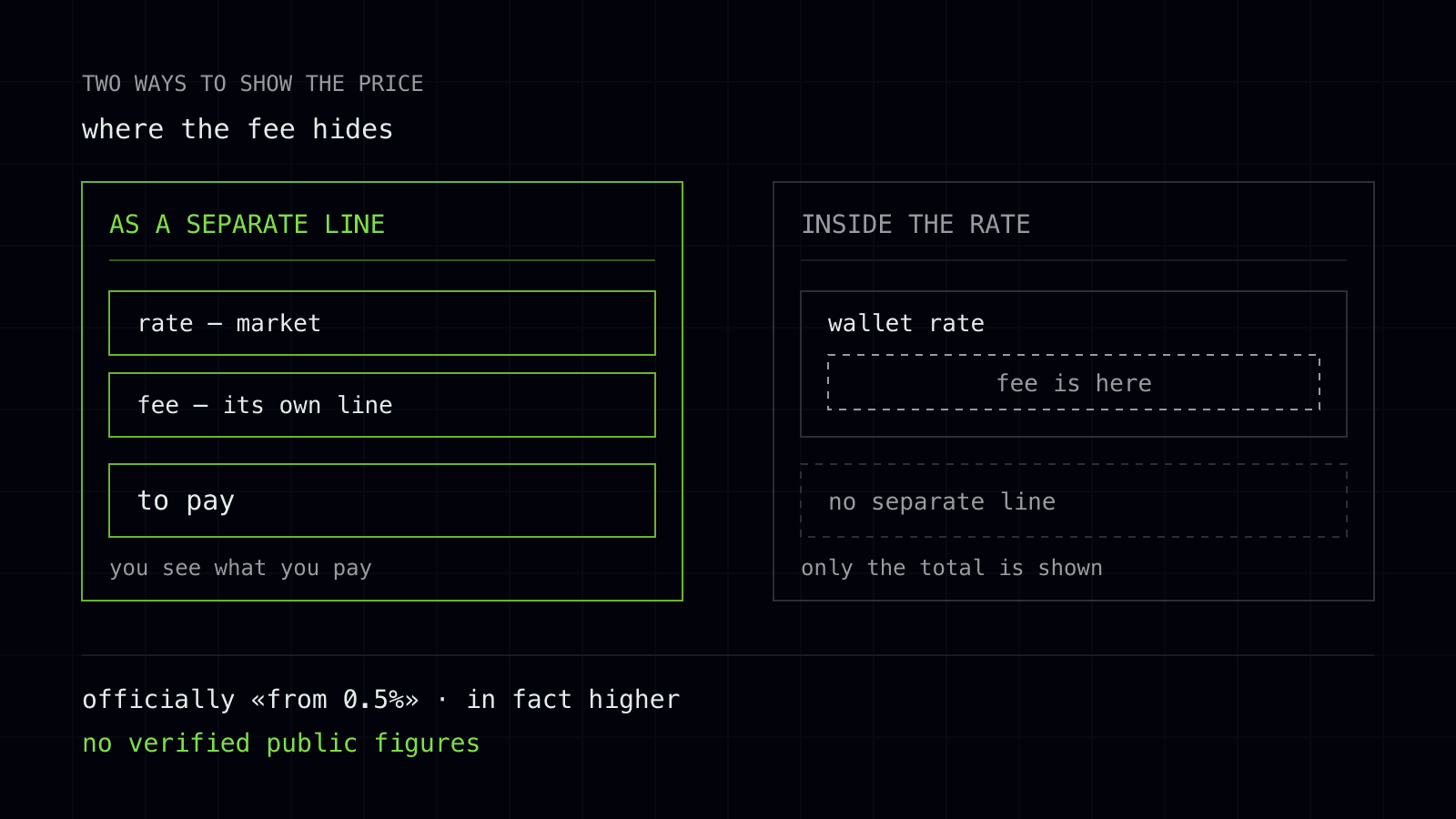
It does have a built-in swap, but the fee is baked into the rate rather than shown as a separate line. That is exactly why it goes unnoticed and is almost always higher than it looks on the confirmation screen.
Below we cover the three things that decide whether this wallet suits you: the key storage model, how open the code is, and the mechanics of the built-in swap.
What non-custodial means and why it is the main thing
Non-custodial means only you control the keys. The company holds no copy, has no access to your funds and cannot freeze the wallet on request.
The flip side is just as direct: if you lose your recovery phrase, there is nobody to restore it. There is no department that will check your passport and give your access back.
How this differs from an exchange account
In that on an exchange you have no coins. You have a record in the company's database of how much it owes you. The exchange controls the keys and you control your account with it, and those are different things that coincide only while the company operates normally.
Which gives you four practical differences. First: access. An account is recovered through email and documents, a non-custodial wallet only through the recovery phrase, and no other way. Forget your exchange password and you write to support. Lose your phrase and there is nobody to write to.
Second: control over withdrawals. An exchange can suspend withdrawals: on an internal check, at a regulator's demand, because of a technical failure. Nobody stops a transaction from your own wallet, because you sign it, not an intermediary.
Third: the risk of the company itself. Funds on an exchange share its fate. If it halts operations, your balance turns into a claim against it rather than coins. A key in your own wallet has no such dependency at all.
Fourth: insurance against your own mistake. There is none. Pick the wrong network on a withdrawal, send to the wrong address, hand your words to a scammer, and there is nobody to recover it from. On an exchange, support does sometimes untangle a share of such cases, and that is exactly the option the non-custodial model removes along with the intermediary.
So the choice here is not better or worse, it is how much responsibility you are willing to carry yourself. An exchange is convenient for trading and for amounts you move actively. Your own wallet fits when the coins are simply meant to sit still.
Hot mode by default adds one more layer of risk. The key lives on a device with a browser, messengers and installed software.
For amounts you would hate to lose, the industry's standard advice is different: a cold wallet with the key kept offline. Exodus supports pairing with a hardware device, and for large balances that is the smarter setup.
How open the Exodus code is
The code is only partly open. Some components are published on GitHub, but the core, key generation and transaction signing, is closed. The company's reasoning: protection against counterfeit clones that attackers assemble from someone else's code and distribute as the original.
We are not judging that decision as good or bad, it has an understandable motive. What matters is the consequence, and that part is unambiguous.
There is no way for an outsider to independently verify the very part that creates and uses your keys. Trust in that part rests on the company's reputation, not on a code review.
The practical conclusion is simple. If your criterion is that the cryptography can be inspected by an outside auditor, this wallet does not meet it. If your criterion is convenience and support for many networks and tokens, it works as intended.
How the built-in swap fee works
Swapping inside the wallet looks free, and that is the whole point. You never see a line reading fee: X. You see one number, how much you will receive. The service's cut is already inside that number, through the rate.
Officially the company states a fee of from 0.5%. The word from does all the work here: in practice it is noticeably higher and depends on the pair and the amount.
Exactly how much higher, we honestly cannot say. No verified public figures for the markup exist. The numbers circulating online come from low-quality sources, and one of them is a direct competitor of Exodus. Repeating them would mean passing off someone else's advertising as fact.
Separate from that markup there is the network fee for the transaction itself. It has nothing to do with the wallet and depends on how busy the blockchain is.
How to measure the markup yourself
There is one method and it takes two minutes. Open a quote in the wallet for the amount and pair you need, and note how much you would receive.
At the same time, in the same minute, look up the market rate for that pair on a major exchange. Work out how much you would get there for the same amount and compare the totals.
The key word is simultaneously. The rate moves, and a measurement taken half an hour apart shows nothing. The difference you see is the full cost of convenience: the spread plus the service's cut.
Repeat it on two or three amounts, a small one and a large one. It often turns out that the cost behaves counterintuitively in percentage terms.
We will name our own interest out loud: we are an exchange service, and in a section about comparing exchanges we have one. So we are not handing you a verdict, we are handing you a method. A figure from your own measurement on your own pair is worth more than anyone else's claim.
When the built-in swap is worth it
More often than it seems after a discussion about hidden fees. Small amounts: when it is a few dozen dollars, the rate difference is pennies while the time and effort of an alternative are real.
Speed: the operation takes a minute, with no transfers back and forth. Not wanting more accounts: no registration, no verification, no handing documents to a third party.
It is not worth it in the opposite case. A large amount, time on your hands, and the rate difference turns into real money. Then it makes sense to compare options, after running that same measurement first.
The summary is short. Exodus honestly does what it promises: it gives you control of the keys and takes payment for convenience through the rate. The two things worth watching are your recovery phrase and the size of the markup on your own amounts.